

Garage door repair is a unique niche in home services. About half of your potential customers have an emergency — a door that won’t open, a broken spring at 7 AM when they need to get to work, or a door that came off its tracks. The other half are planning an upgrade — a new opener, insulated door, or full replacement.
That split means your Google Ads strategy needs to handle two very different customer mindsets. Emergency customers need speed and trust. Installation customers need options and pricing. Running a single campaign for both wastes money and underperforms.
This guide breaks down how to structure, target, and optimize Google Ads specifically for garage door repair and installation companies.
Emergency vs Planned Garage Door Services
Understanding the search intent split is critical for your campaign structure:
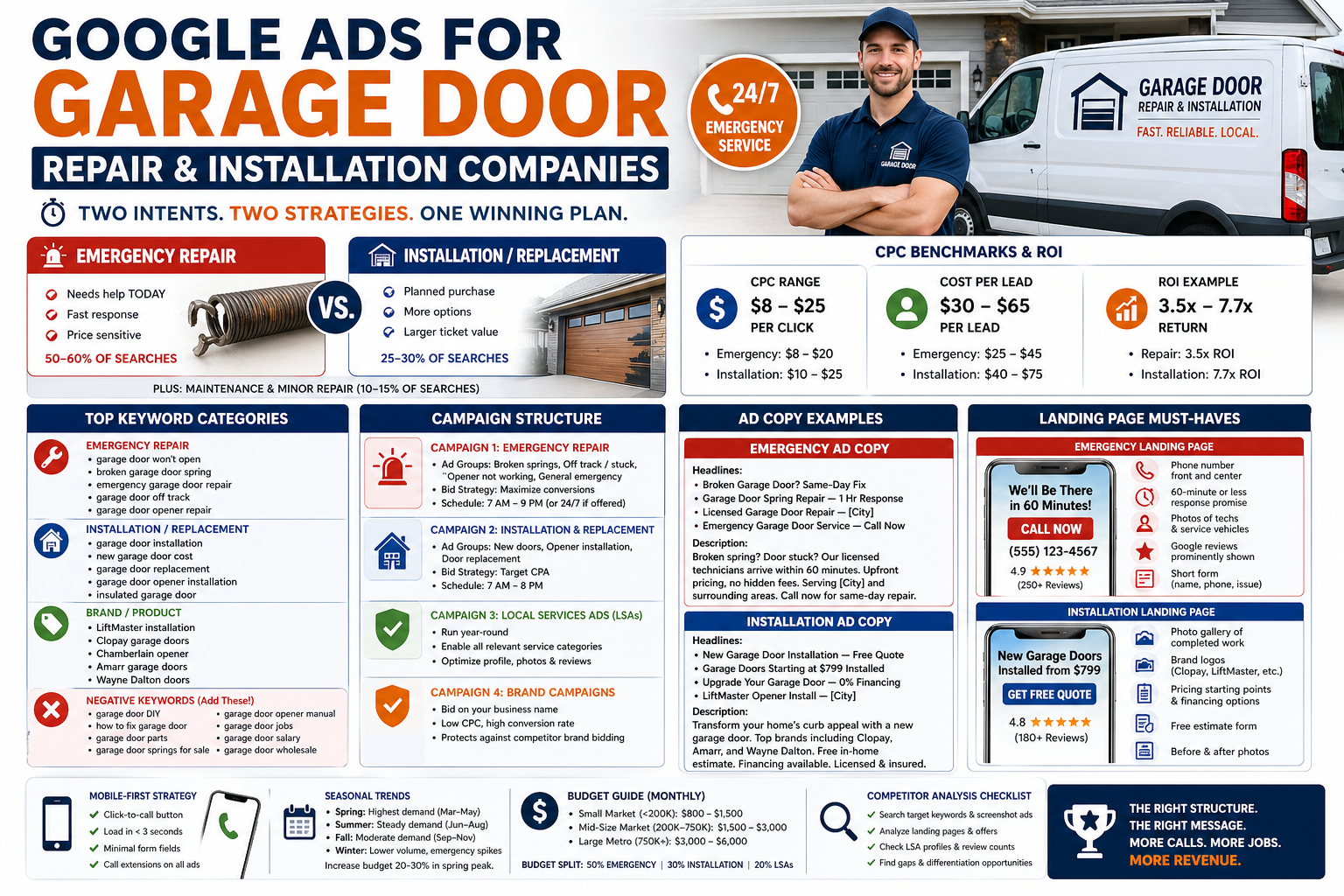
Emergency searches (50-60% of volume): “Garage door won’t open,” “broken garage door spring,” “garage door stuck,” “emergency garage door repair near me.” These customers need help today, often within hours. They convert fast but are also price-sensitive because they weren’t expecting this expense.
Installation and replacement searches (25-30%): “New garage door cost,” “garage door replacement,” “garage door opener installation,” “insulated garage door.” These are planned purchases with higher ticket values ($800-$3,000+) but longer decision cycles. Customers may get 2-3 quotes before committing.
Maintenance and minor repair (10-15%): “Garage door tune-up,” “garage door lubrication,” “garage door alignment.” Lower ticket values but good for building a customer base for future replacements.
Your budget allocation should roughly follow this intent distribution, with slightly more weight toward emergency keywords because they convert faster and more reliably.
Keyword Strategy
Emergency Repair Keywords (Highest Priority)
- garage door repair near me
- broken garage door spring
- garage door won’t open
- emergency garage door repair
- garage door off track
- garage door cable repair
- garage door spring replacement
- garage door not closing
- garage door opener repair
Installation Keywords
- garage door installation
- new garage door cost
- garage door replacement
- garage door opener installation
- insulated garage door
- custom garage door
- two car garage door
- smart garage door opener
Brand and Product Keywords
- LiftMaster installation
- Chamberlain opener
- Clopay garage doors
- Amarr garage doors
- Wayne Dalton doors
Negative Keywords to Add Immediately
- garage door DIY
- how to fix garage door
- garage door parts
- garage door springs for sale
- garage door opener manual
- garage door jobs
- garage door salary
- garage door wholesale
CPC Benchmarks
Garage door repair CPCs are moderate compared to other home services:
Emergency repair keywords: $8-$20 per click. “Broken garage door spring” and “garage door won’t open” tend to be on the higher end.
Installation keywords: $10-$25 per click. New door installation keywords are more competitive because the ticket value is higher.
Average cost per lead: $30-$65. Emergency repair leads typically cost $25-$45, while installation leads range from $40-$75 due to the higher competition and longer sales cycle.
ROI math: At a $45 average CPL and a $400 average repair ticket with a 40% close rate, you’re spending about $112 per new customer for $400 in revenue — a 3.5x return. For installations averaging $2,000 with a 25% close rate, you’re spending about $260 per customer for $2,000 in revenue — a 7.7x return.
Campaign Structure
Campaign 1: Emergency Repair - Ad Group: Broken springs - Ad Group: Door off track / stuck - Ad Group: Opener not working - Ad Group: General emergency repair - Bid strategy: Maximize conversions - Schedule: 7 AM - 9 PM daily (or 24/7 if you offer after-hours service)
Campaign 2: Installation & Replacement - Ad Group: New garage doors - Ad Group: Opener installation - Ad Group: Door replacement - Bid strategy: Target CPA - Schedule: 7 AM - 8 PM daily
Campaign 3: LSAs - Run year-round - Enable all relevant service categories
Campaign 4: Brand campaigns (if applicable) - Bid on your business name - Low CPC, high conversion rate - Protects against competitor brand bidding
Ad Copy for Emergency vs Installation
Emergency Ad Copy
Headlines: - “Broken Garage Door? Same-Day Fix” - “Garage Door Spring Repair — 1 Hr Response” - “Licensed Garage Door Repair — [City]” - “Emergency Garage Door Service — Call Now”
Descriptions: “Broken spring? Door stuck? Our licensed technicians arrive within 60 minutes. Upfront pricing, no hidden fees. Serving [City] and surrounding areas. Call now for same-day repair.”
Installation Ad Copy
Headlines: - “New Garage Door Installation — Free Quote” - “Garage Doors Starting at $799 Installed” - “Upgrade Your Garage Door — 0% Financing” - “LiftMaster Opener Install — [City]”
Descriptions: “Transform your home’s curb appeal with a new garage door. Top brands including Clopay, Amarr, and Wayne Dalton. Free in-home estimate. Financing available. Licensed and insured.”
Landing Page Best Practices
Emergency landing page: Phone number as the dominant element. “We’ll be there in 60 minutes” or similar response time promise. Photos of your uniformed technicians and service vehicles. Google review rating prominently displayed. Short form as an alternative to calling (name, phone, issue description).
Installation landing page: Photo gallery of completed installations. Brand logos (Clopay, LiftMaster, etc.). Pricing starting points (“New doors from $799 installed”). Free estimate form. Financing options. Before-and-after project photos.
Both pages should load in under 3 seconds and be fully optimized for mobile. Over 65% of garage door searches happen on phones — often from someone standing in their driveway looking at a broken door.
LSAs for Garage Door Companies
Local Services Ads are highly effective for garage door businesses. The Google Verified badge is particularly valuable because garage door repair, like locksmithing, has issues with scam operators who advertise low prices and gouge customers on-site.
Lead costs: $20-$50 per lead through LSAs, depending on your market.
Profile tips: Add photos of completed work (especially before/after), list all services (spring repair, opener installation, new doors, emergency service), and maintain fast response times.
Review focus: Aim for 50+ reviews with a 4.5+ rating. Ask emergency repair customers for reviews immediately after completing the job — they’re most grateful (and most likely to leave a review) right after you solved their problem.
Mobile-First Strategy
Garage door emergencies happen when people are standing in their driveway or garage. They’re searching on their phone, often frustrated and in a hurry.
Your entire ad-to-conversion experience needs to be mobile-optimized:
Click-to-call buttons should be the most prominent element on your landing page. Make them large enough to tap easily with one hand.
Page load speed under 3 seconds. Test with Google’s PageSpeed Insights tool.
Minimal form fields. For emergency requests, name and phone number is enough. Don’t ask for email, address, and a detailed description of the problem — that’s friction that kills conversions.
Call extensions on all ads. Every ad should show your phone number so customers can call directly from the search results without even visiting your landing page.
Seasonal Trends
Garage door demand has subtle seasonal patterns:
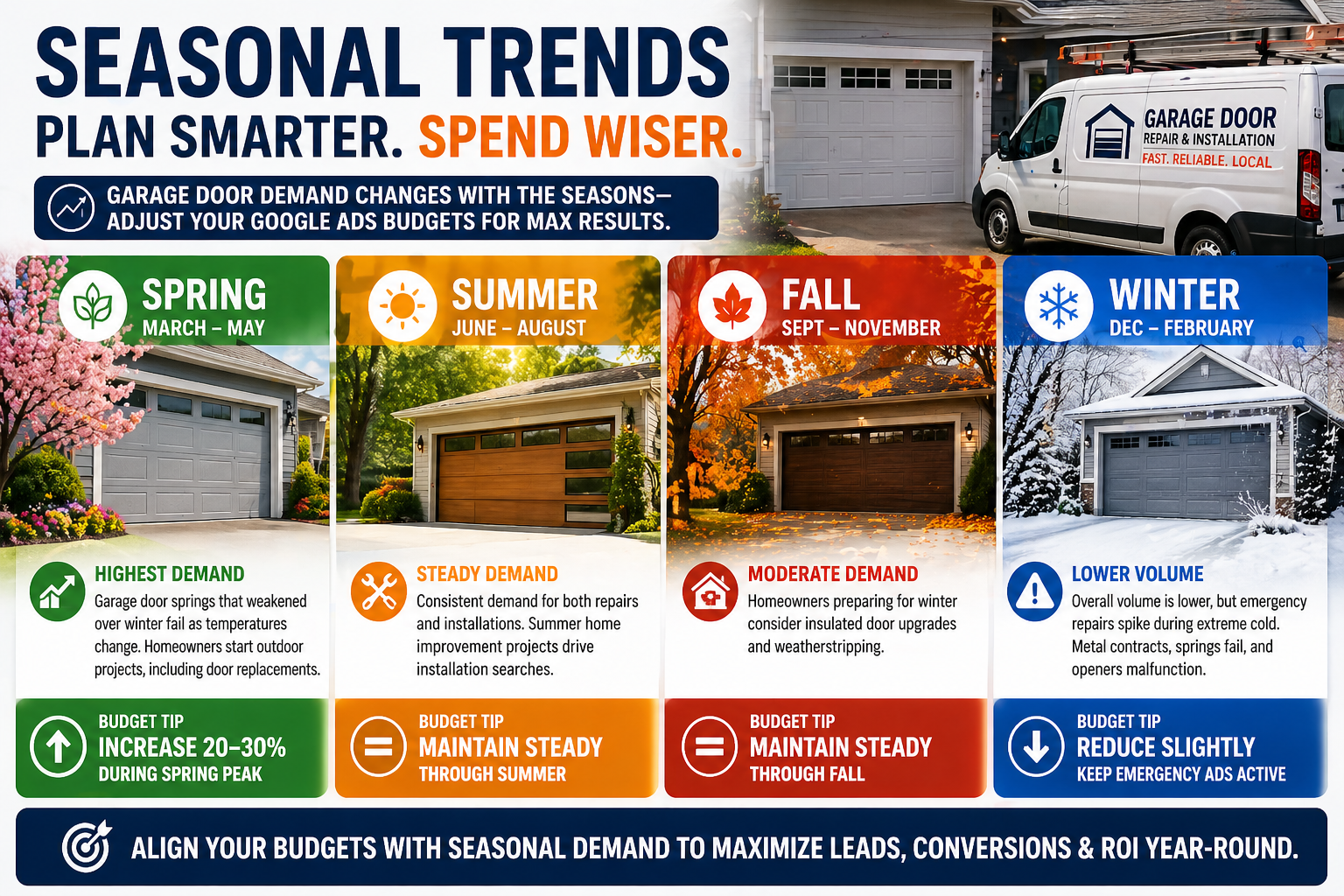
Spring (March-May): Highest demand. Garage door springs that weakened over winter fail as temperatures change. Spring is also when homeowners start outdoor projects, including door replacements.
Summer (June-August): Steady demand for both repairs and installations. Summer home improvement projects drive installation searches.
Fall (September-November): Moderate demand. Homeowners preparing for winter consider insulated door upgrades and weatherstripping.
Winter (December-February): Lower overall volume, but emergency repairs spike during extreme cold (metal contracts, springs fail, openers malfunction in freezing temperatures).
Adjust your budgets accordingly: increase 20-30% during spring peak, maintain steady through summer and fall, and reduce slightly in winter while keeping emergency campaigns active.
Budget Recommendations
Small market (under 200K population): $800-$1,500/month. Focus on emergency repair keywords and LSAs.
Mid-size market (200K-750K): $1,500-$3,000/month. Add installation campaigns alongside emergency and LSAs.
Large metro (750K+): $3,000-$6,000/month. Full campaign coverage across all service types plus competitive brand defense.
Budget split: 50% emergency repair, 30% installation/replacement, 20% LSAs. Adjust based on which service type drives more revenue for your business.
Competitor Analysis
Study your local competitors’ Google Ads strategies:
Search for your target keywords and screenshot the ads that appear. Note their headlines, descriptions, prices mentioned, and special offers.
Check their landing pages. Are they using dedicated landing pages or their homepage? What trust signals do they display?
Monitor their LSA profiles. How many reviews do they have? What’s their rating? What services do they list?
Identify gaps. If no competitor mentions financing in their ads, that’s your differentiation opportunity. If everyone advertises spring repair but nobody mentions opener installation, there’s an underserved keyword opportunity.
The garage door repair industry is competitive but not as saturated as plumbing or HVAC in most markets. A well-structured Google Ads campaign with proper keyword targeting, strong landing pages, and LSAs can quickly establish your business as the go-to provider in your service area.
