

If you’re running Google Ads for your plumbing business and your cost per lead is climbing - or was never where you wanted it - you’re not alone. Plumbing CPCs have increased steadily as more plumbers enter the Google Ads market, and without proactive optimization, your cost per lead will keep rising.
The good news: there are specific, proven tactics that consistently lower CPL for plumbing businesses. Most don’t require more ad spend. They require smarter ad spend.
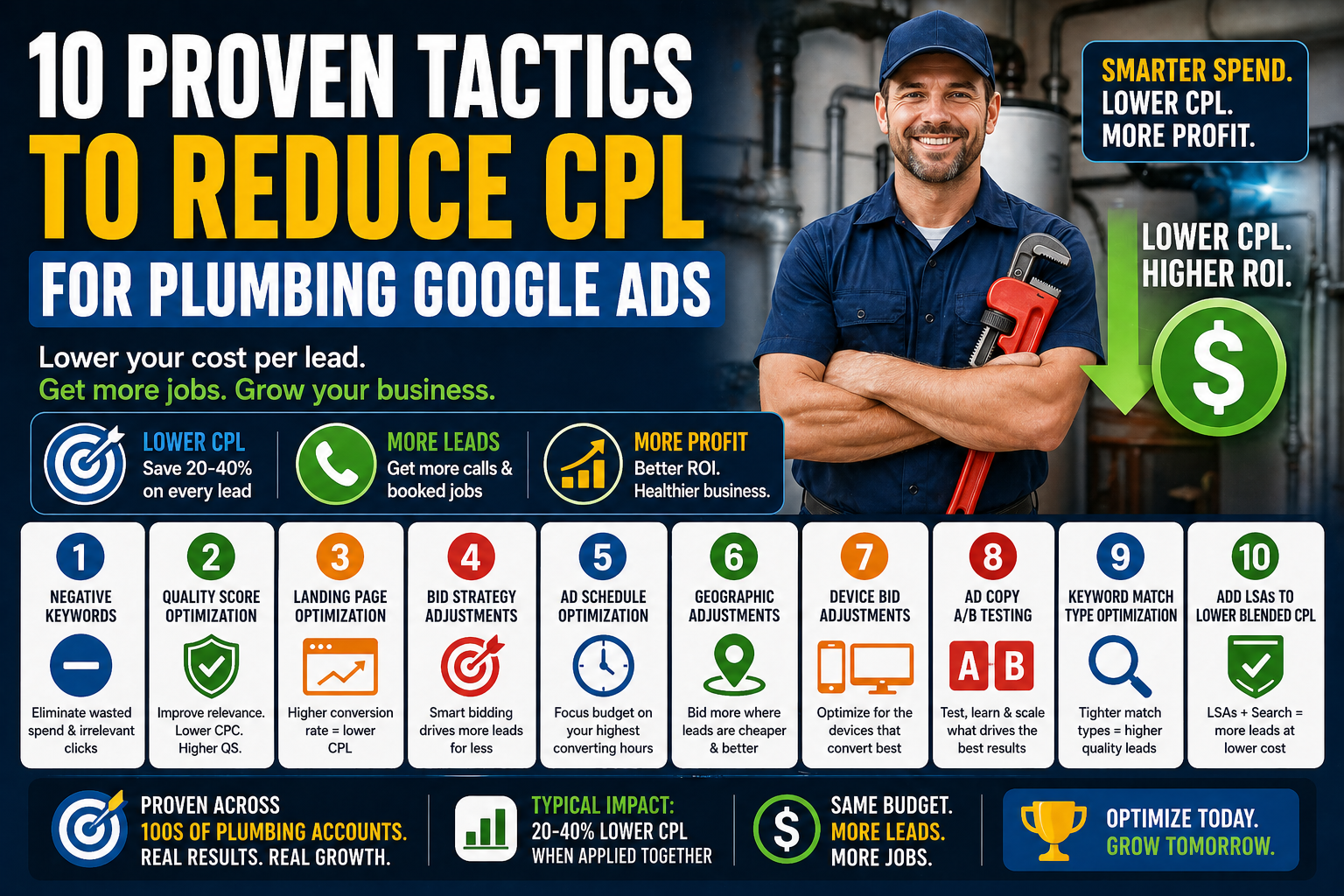
This guide covers 10 tactics that have been tested across hundreds of plumbing Google Ads accounts. Some deliver quick wins within days. Others take a few weeks to show impact. Applied together, they can reduce your cost per lead by 20-40%.
Understanding Your Current CPL
Before optimizing, establish your baseline. In Google Ads, go to Campaigns and look at your “Cost / Conv.” column. If you’re not seeing this column, customize your columns and add it.
Benchmark CPLs for plumbing Google Ads (2026): - Emergency plumbing: $30-$60 per lead - Drain cleaning: $20-$40 per lead - Water heater services: $35-$65 per lead - General plumbing: $25-$50 per lead - Blended average: $30-$55 per lead
If your CPL is above these ranges, there’s significant room for improvement. If you’re within range, optimization can still help - even a 15% reduction in CPL adds up over months.
Important note: Make sure your conversion tracking captures phone calls AND form submissions. If you’re only tracking forms, your CPL looks artificially high because you’re missing 60-80% of your actual leads (which come through phone calls).
10 Proven Tactics to Reduce CPL
Tactic 1: Aggressive Negative Keywords
This is the fastest and highest-impact CPL reduction tactic. A comprehensive negative keyword list prevents your ads from showing for irrelevant searches - immediately eliminating wasted clicks.
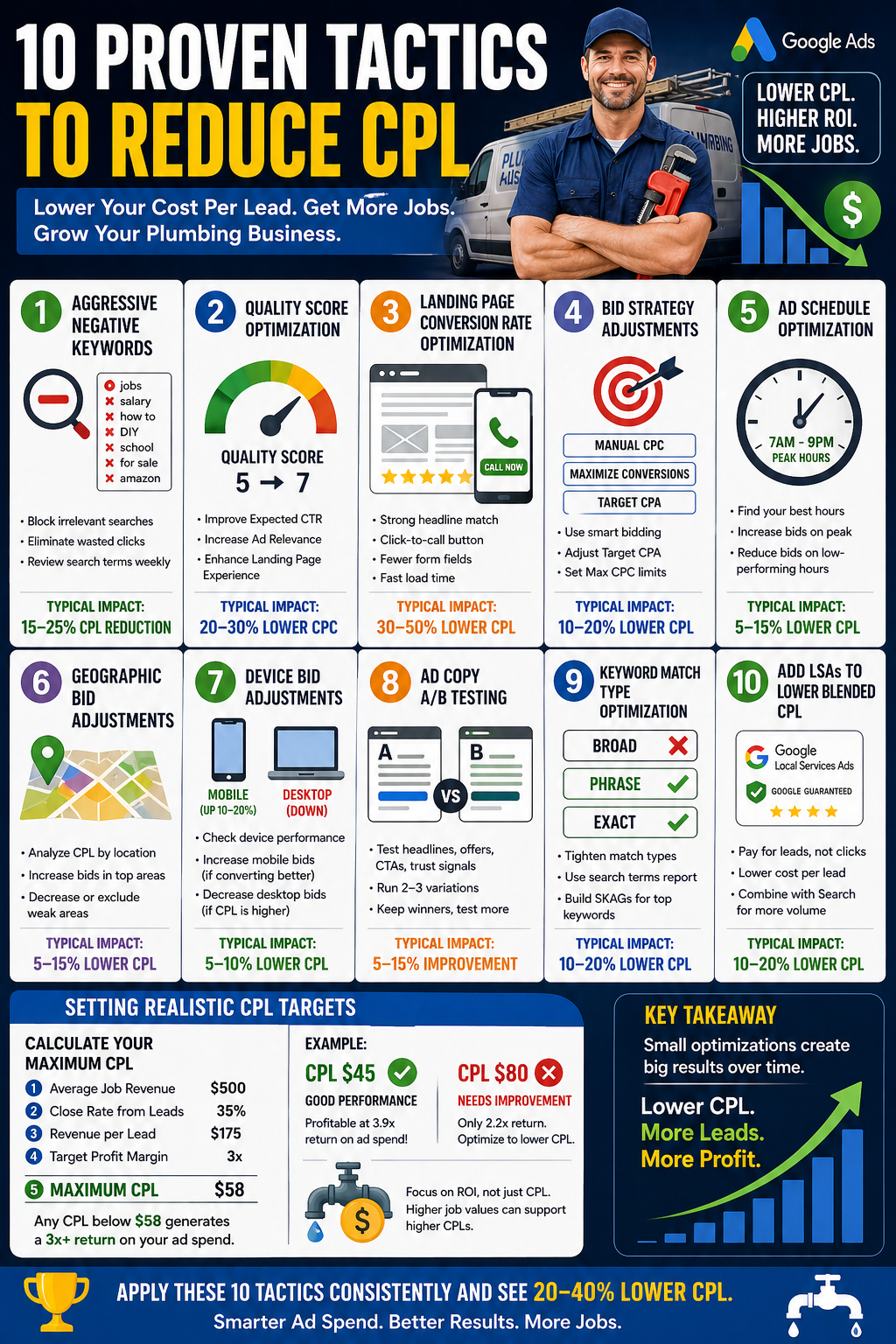
Typical impact: 15-25% CPL reduction within the first week.
Add negatives for: job seekers (jobs, salary, career, hiring), DIYers (how to, tutorial, DIY), students (school, course, training), retail shoppers (for sale, buy, parts, supplies, Amazon, Home Depot), and geographic areas outside your service territory.
Review your Search Terms report weekly and add new negatives as you find them. This is not a one-time task - new irrelevant searches surface constantly.
Tactic 2: Quality Score Optimization
Quality Score is Google’s 1-10 rating of your ad’s relevance. A higher Quality Score directly lowers your cost per click, which lowers your cost per lead.
Quality Score has three components:
Expected CTR: How likely people are to click your ad. Improve this by writing compelling, relevant headlines and descriptions. Include your target keyword in the headline.
Ad relevance: How closely your ad matches the search query. Improve this by creating tightly themed ad groups with specific ad copy for each group of related keywords. Don’t use the same ad for “drain cleaning” and “water heater repair.”
Landing page experience: How relevant and useful your landing page is to people who click. Improve this with service-specific landing pages that match your ad copy, fast load times, and mobile optimization.
Typical impact: Improving Quality Score from 5 to 7 can reduce CPC by 20-30%, which directly lowers CPL by the same amount.
Tactic 3: Landing Page Conversion Rate Optimization
Your landing page conversion rate is the single biggest lever for CPL. Doubling your conversion rate cuts your CPL in half - without changing your ad spend at all.
Quick wins for conversion rate: - Add a large, prominent click-to-call button on mobile - Match the landing page headline to the ad headline - Add your Google review rating above the fold - Reduce form fields to 3-4 maximum - Add a sticky “Call Now” button on mobile - Ensure page loads in under 3 seconds
Typical impact: A landing page that converts at 10% instead of 5% cuts your CPL by 50%. Even a modest improvement from 8% to 12% reduces CPL by 33%.
Tactic 4: Bid Strategy Adjustments
Your bid strategy determines how much you pay per click and how Google allocates your budget.
If you’re using Manual CPC: Consider switching to “Maximize Conversions” or “Target CPA.” These automated strategies use Google’s machine learning to bid higher when a conversion is likely and lower when it’s not. They typically outperform manual bidding once you have 30+ conversions per month.
If you’re already using Target CPA: Lower your target CPA gradually (10% at a time) to see if Google can deliver leads at a lower cost. Dropping too aggressively causes Google to stop bidding on searches, so make gradual adjustments.
If you’re using Maximize Conversions: Set a maximum CPC limit to prevent Google from overspending on individual clicks. Without a limit, Google may pay $30+ per click in competitive auctions.
Typical impact: 10-20% CPL reduction from bid strategy optimization.
Tactic 5: Ad Schedule Optimization
Not all hours of the day produce equal results. Your CPL at 3 AM might be double your CPL at 10 AM - or vice versa.
How to find your peak hours: Run a Day & Hour report in Google Ads (Reports → Predefined Reports → Time → Day & Hour). Identify hours with high CPL and low conversion rates.
Action: Reduce bids during your worst-performing hours and increase bids during your best-performing hours. For emergency plumbing, peak conversion hours are typically 7 AM - 9 PM on weekdays and all day on weekends.
Typical impact: 5-15% CPL reduction by shifting budget toward high-converting hours.
Tactic 6: Geographic Bid Adjustments
Different areas within your service territory produce leads at different costs. Urban cores tend to have higher CPCs (more competition) while suburban areas may convert better.
How to analyze: Run a Geographic report to see CPL by city, zip code, or region.
Action: Increase bids in areas with low CPL and high conversion rates. Decrease bids (or exclude entirely) areas with high CPL and low conversion rates.
Also consider: Excluding areas at the edges of your service territory. Leads from 25+ miles away often have lower close rates because customers can find closer plumbers.
Typical impact: 5-15% CPL reduction.
Tactic 7: Device Bid Adjustments
Mobile and desktop traffic often convert at different rates for plumbing services. Emergency searches skew heavily mobile (70%+), while installation research may lean desktop.
Check your device performance: View performance by device in your campaign settings.
Action: If mobile converts at a higher rate (common for emergency services), increase mobile bids by 10-20%. If desktop has a significantly higher CPL, decrease desktop bids.
Typical impact: 5-10% CPL reduction.
Tactic 8: Ad Copy A/B Testing
Small changes in ad copy can significantly impact both click-through rate and conversion rate, both of which affect CPL.
Elements to test: - Headline phrasing: “24/7 Emergency Plumber” vs “Emergency Plumber - Call Now” - Including specific pricing: “$89 Drain Cleaning” vs “Affordable Drain Cleaning” - Response time claims: “30 Minute Response” vs “Same-Day Service” - Trust signals in ads: “Licensed & Insured” vs “4.9★ Rated” - CTA variations: “Call Now” vs “Get a Free Quote” vs “Book Online”
How to test: Create 2-3 ad variations in each ad group and let Google rotate them. After 200+ impressions per ad, compare CTR and conversion rate. Pause the underperformer and create a new challenger.
Typical impact: 5-15% CPL improvement per winning test.
Tactic 9: Keyword Match Type Optimization
Broad match keywords can drive lower-quality traffic with higher CPL. Phrase and exact match keywords give you more control.
Review your keyword match types: Are your highest-CPL keywords on broad match? Consider switching them to phrase or exact match to reduce irrelevant traffic.
Use the search terms report: If broad match keywords trigger many irrelevant searches (even after adding negatives), switch those keywords to phrase match.
Single keyword ad groups (SKAGs): For your highest-volume, highest-value keywords, consider creating dedicated ad groups with a single exact match keyword and highly specific ad copy. This maximizes relevance and Quality Score.
Typical impact: 10-20% CPL reduction by tightening match types on high-spend keywords.
Tactic 10: Adding LSAs to Lower Blended CPL
Local Services Ads often have a lower cost per lead than search ads because you only pay for actual leads (not clicks). Adding LSAs to your mix lowers your blended CPL across all Google advertising.
Typical LSA CPL for plumbing: $20-$45, compared to $30-$55 for search ads.
Action: If you’re not already running LSAs, get verified and launch them. The combination of search ads and LSAs gives you more total leads at a lower blended cost.
Typical impact: Adding LSAs can lower your blended CPL by 10-20%.
Setting Realistic CPL Targets
Your target CPL should be based on your business economics, not arbitrary benchmarks:
Calculate your maximum CPL: 1. Average plumbing job revenue: $500 (example) 2. Close rate from leads: 35% 3. Revenue per lead: $500 × 35% = $175 4. Target profit margin on ad spend: 3x return 5. Maximum CPL: $175 ÷ 3 = $58
In this example, any CPL below $58 generates a 3x+ return on your ad spend. If your current CPL is $45, you’re performing well. If it’s $80, you need to optimize.
Adjust these inputs based on your actual numbers. Plumbers with higher average ticket sizes (water heater installations, sewer line replacements) can afford higher CPLs because each conversion is worth more.
When Higher CPL Is Actually OK
Not all leads are equal. A higher CPL is acceptable - even desirable - in these situations:
High-ticket services: A $65 CPL for water heater installation leads (average job: $2,500) is more profitable than a $25 CPL for drain cleaning leads (average job: $200).
Competitive seasons: During peak demand (heat waves, cold snaps), CPCs rise across the board. A temporarily higher CPL during these periods is acceptable because you’re capturing urgent, high-value customers who need service immediately.
New market entry: When you’re expanding into a new service area, initial CPL will be higher as Google’s algorithm learns and your campaigns optimize. Plan for a 2-3 month ramp-up period.
Brand building: Some branded keyword campaigns have very low CPL but are really just capturing existing customers. Your non-branded campaigns will always have a higher CPL, and that’s expected - they’re acquiring new customers.
The ultimate metric isn’t cost per lead - it’s return on ad spend. Focus on the revenue your ads generate relative to what you spend, not just the cost of acquiring each lead.
