

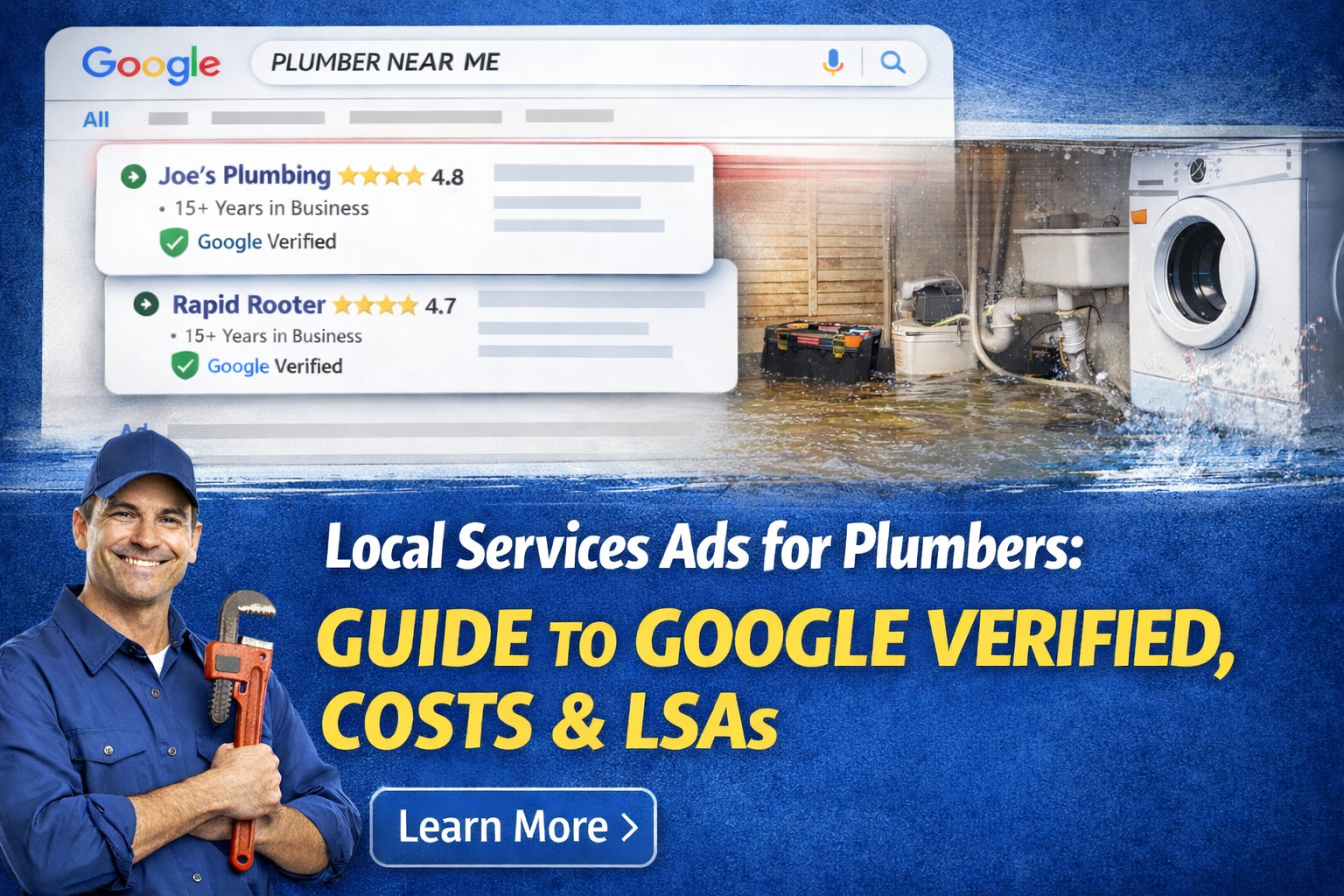
If you’re a plumber running Google Ads without Local Services Ads, you’re leaving money - and trust - on the table.
Local Services Ads sit at the very top of Google search results. Above regular search ads. Above organic results. Above everything. They display your business name, star rating, years in business, and most importantly, a Google Verified badge that tells customers Google has vetted your business.
For plumbers, this badge is worth more than any other trust signal you can display. When a homeowner’s basement is flooding and they’re picking between search results, the plumber with the Google Verified badge gets the call.
This guide walks you through everything from initial setup to advanced optimization, so you can get the most out of LSAs for your plumbing business in this year.
What Are LSAs and Why They Matter for Plumbers
Local Services Ads are Google’s pay-per-lead advertising platform designed specifically for local service businesses. Unlike traditional Google Search Ads where you pay per click, LSAs charge you only when a customer contacts you directly through the ad - either by calling or sending a message.
This fundamental difference is what makes LSAs so attractive for plumbers:
Pay-per-lead, not pay-per-click. Every dollar you spend generates an actual customer contact, not just a website visit. No more paying for clicks from people who visit your site and leave without calling.
Prime placement. LSAs appear at the very top of Google results - above paid search ads and organic listings. On mobile, they take up the entire first screen.
Trust signal built in. The Google Verified badge (formerly Google Guaranteed) tells customers that your business has passed Google’s verification process. For plumbing, where customers worry about letting strangers into their homes, this trust signal is powerful.
Simplicity. No keyword management, no ad copy writing, no landing page optimization. Google handles the matching based on the services you offer and your proximity to the searcher.
Google Verified Badge (Formerly Google Guaranteed)
Google rebranded “Google Guaranteed” to “Google Verified” in 2024, but the core concept remains the same. The badge means Google has verified that your plumbing business is licensed, insured, and has passed background checks.
For customers, the badge provides additional confidence. Google backs verified businesses with a satisfaction guarantee - if a customer isn’t happy with the quality of work, Google may refund up to the amount paid for the job (subject to certain limits and conditions).
For your business, the badge is the single most powerful conversion driver in your marketing arsenal. Plumbers with the Google Verified badge consistently see higher contact rates than those without it.
Eligibility Requirements
To run LSAs for a plumbing business, you need to meet these requirements:
Business license. You must have a valid plumbing license for your service area. Google will verify this through a third-party background check provider.
Insurance. You need general liability insurance that meets your state’s minimum requirements. Google will request proof of coverage, and your policy must remain active for the duration of your LSA campaigns.
Background checks. Google requires background checks on the business owner and any field workers who will enter customer homes. These are conducted through a third-party provider (currently Evident or Pinkerton, depending on your location).
Business location. You must operate in a geographic area where LSAs are available for plumbing services. As of now, LSAs cover most US markets.
Active Google Business Profile. Your Google Business Profile must be claimed, verified, and up to date.
Step-by-Step Setup Process
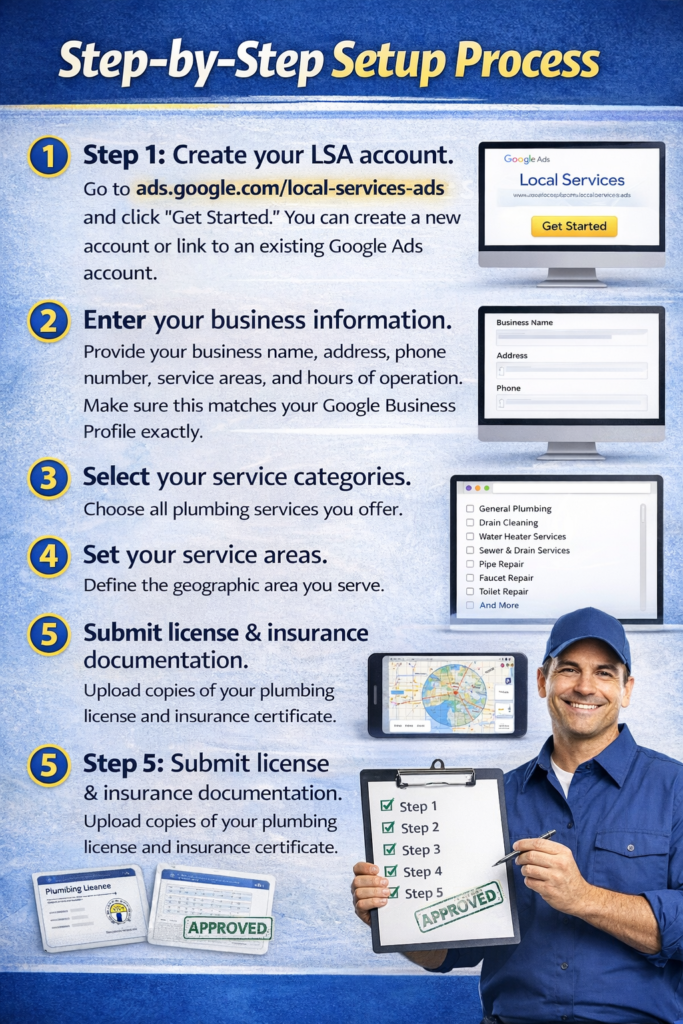
Step 1: Create your LSA account. Go to ads.google.com/local-services-ads and click “Get Started.” You can create a new account or link to an existing Google Ads account.
Step 2: Enter your business information. Provide your business name, address, phone number, service areas, and hours of operation. Make sure this matches your Google Business Profile exactly.
Step 3: Select your service categories. Choose all plumbing services you offer. Available categories typically include general plumbing, drain cleaning, water heater repair/installation, sewer line services, pipe repair, faucet repair, toilet repair, and emergency plumbing. Select every relevant category - more categories mean more potential matches.
Step 4: Set your service areas. Define the geographic area you serve. You can set this by zip codes, cities, or a radius around your business address. Be honest about your service area - accepting leads from too far away wastes your budget and hurts your response time metrics.
Step 5: Submit license and insurance documentation. Upload copies of your plumbing license and insurance certificate. Google’s verification partner will review these.
Step 6: Complete background checks. You’ll receive an email with instructions for initiating background checks through Google’s partner. Each person who needs a background check will need to provide their Social Security number and consent to the check.
Step 7: Set your weekly budget. This is the maximum you’re willing to spend per week on LSA leads. Start conservatively - you can always increase later.
Step 8: Wait for verification. This typically takes 2-4 weeks. Google will notify you when your profile is approved and your ads start running.
Verification Timeline
Plan for 3-4 weeks from start to finish. Here’s a typical timeline:
Week 1: Submit application, upload documents, initiate background checks.
Week 2: Background checks processing. This is usually the longest step.
Week 3: Google reviews your license and insurance documentation.
Week 3-4: Profile goes live, ads start appearing.
Some businesses get verified faster (10-14 days), while others experience delays, especially if background check results take longer or if there are issues with documentation. Submit everything accurately the first time to avoid delays from resubmissions.
Profile Optimization
Once verified, your LSA profile is what determines whether customers choose you over competitors. Optimize every element:
Business hours. Set accurate hours, including emergency/after-hours availability. Google uses your hours to determine when to show your ads. If you offer 24/7 emergency service, make sure your profile reflects that.
Service categories. Ensure all your services are selected. Many plumbers miss categories like “gas line repair” or “water filtration installation” that could bring in additional leads.
Photos. Upload high-quality photos of your team, your vehicles, and your work. Photos of real plumbers in uniform build trust. Include before-and-after photos of completed projects. Google recommends at least 3-5 photos, but more is better.
Business description. Write a clear, concise description that highlights your specialties, years of experience, certifications, and what makes you different. Include your service area and any special qualifications (master plumber license, specific brand certifications).
Response time. Google tracks how quickly you respond to LSA leads. Faster response times improve your ranking. Aim to respond to every lead within 5 minutes during business hours.
Ranking Factors for LSAs
LSA rankings aren’t random - Google uses specific signals to determine which businesses appear first:
Proximity. How close your business is to the searcher. This is the most heavily weighted factor. You can’t change your physical location, but you can optimize your service area settings.
Reviews. Both the quantity and quality of your Google reviews significantly impact your ranking. Businesses with more reviews and higher average ratings rank higher. This is the most actionable ranking factor.
Responsiveness. Google monitors how quickly you respond to leads and whether you miss calls. Businesses that respond promptly rank higher. If you let leads sit for hours or consistently miss calls, your ranking will drop.
Business hours. Being open when a customer searches gives you priority. Plumbers with 24/7 availability or extended hours have an advantage, especially for emergency searches.
Complaint history. If customers file complaints through Google’s dispute process, it negatively affects your ranking. Deliver quality work and address customer concerns proactively.
Review Strategy for LSA Rankings
Reviews are the single most important thing you can control to improve your LSA ranking. Here’s a systematic approach:
Ask every customer for a review. After completing a job, send a text or email with a direct link to your Google review page. The easiest way is to find your Google review link and save it as a shortened URL you can text to customers.
Time your ask. The best time to request a review is immediately after completing the job, when the customer is most satisfied. Don’t wait days or weeks - the likelihood of getting a review drops dramatically with each day that passes.
Make it easy. Send a direct link that opens the review form pre-populated with 5 stars. The fewer steps the customer has to take, the more reviews you’ll collect.
Respond to every review. Thank customers for positive reviews and address concerns in negative reviews professionally. Google takes review responsiveness into account.
Target volume. Aim for at least 50+ reviews to be competitive in most markets. In larger metros, you may need 100+ reviews to consistently rank at the top of LSA results.
Lead Management and Dispute Process
When a customer contacts you through LSAs, the lead appears in your LSA dashboard and you’ll receive a notification. Here’s how to manage leads effectively:
Respond immediately. Call back within 5 minutes during business hours. Fast response times improve your ranking and increase the chance of booking the job.
Mark lead status. After following up, mark each lead in your dashboard as “booked,” “not booked,” or “archived.” This helps Google understand your conversion patterns.
Dispute invalid leads. Not every lead is a real customer. You can dispute leads for specific reasons: wrong number, spam/bot call, customer looking for a service you don’t offer, or customer outside your service area. Google will review the dispute and credit you if the lead is deemed invalid. Typical dispute approval rates are 40-60%, so don’t be afraid to dispute legitimately bad leads.
Keep detailed records. Note the nature of each lead (emergency vs. planned service, service type, estimated job value) to help you understand which lead types are most profitable.
Budget and Bidding Strategy
LSA budgeting works differently from search ads. You set a weekly budget, and Google tries to deliver leads up to that amount.
Starting budget: For most plumbing businesses, $500-$1,000 per week is a good starting point. This should generate 10-25 leads depending on your market and lead costs.
Budget adjustments: Increase your weekly budget during peak seasons (winter for frozen pipe emergencies, spring for sewer line issues). Decrease during slower periods to maintain profitability.
Maximize vs. set budget mode: Google offers a “Maximize Leads” option that automatically adjusts your budget based on demand. For new LSA advertisers, we recommend setting a fixed weekly budget first to control costs, then experimenting with maximize mode once you understand your lead quality and conversion rates.
LSA Lead Costs
Lead costs vary by market and service type, but here are current benchmarks for plumbing LSAs:
Emergency plumbing leads: $30-$55 per lead. These are the most expensive because they’re the highest intent and typically result in the highest-value jobs.
Drain cleaning leads: $20-$40 per lead. Lower cost because drain cleaning is a more common, lower-ticket service.
Water heater leads: $25-$50 per lead. Mid-range cost with good revenue potential, especially for replacements.
General plumbing leads: $15-$35 per lead. Covers a mix of service requests with varying job values.
Average across all lead types: $25-$45 per lead. At a typical plumbing job value of $300-$1,500 and a lead-to-customer conversion rate of 30-50%, the ROI on LSA leads is usually strong.
Combining LSAs with Search Ads
LSAs and search ads aren’t competitors - they’re complementary. Running both maximizes your visibility on the search results page.
LSAs capture the top position and attract customers who value the Google Verified badge and prefer to call directly.
Search ads capture the middle positions and attract customers who want to visit your website, read reviews, or learn more before calling.
Together, you can appear in both placements for the same search, significantly increasing the likelihood that a potential customer contacts you.
Budget allocation: Most plumbing businesses find an optimal split of 30-40% on LSAs and 60-70% on search ads. Adjust based on which channel delivers a better cost per lead and higher-quality leads.
Common LSA Problems and Solutions
Problem: Low ranking. Your ads rarely show in top positions.
Solution: Increase review count, improve response times, ensure your profile is complete with photos and all service categories. Also check that your service area isn’t set too broadly.
Problem: Low lead quality. You’re getting calls that don’t convert to jobs.
Solution: Review your service category selections - you may have categories enabled that attract the wrong type of customer. Dispute invalid leads to improve your lead quality metrics and get credits.
Problem: Not enough leads. Your budget isn’t being fully spent.
Solution: Expand your service area, add more service categories, and focus on increasing reviews to improve your ranking.
Problem: Too many leads. You’re getting more calls than you can handle.
Solution: Decrease your weekly budget, narrow your service area to your most profitable zones, or increase your team’s capacity to handle more calls.
Problem: Background check delays. Verification is taking longer than expected.
Solution: Contact Google’s LSA support team for a status update. Ensure all required information was submitted correctly.
This year LSA Changes and Updates
Google continually updates the LSA platform. Here are the key changes affecting plumbers in this year:
Google Verified replaces Google Guaranteed. The rebrand is complete, but the functionality is the same. The verification process, badge display, and satisfaction guarantee remain in place.
Enhanced review display. LSAs now show review highlights - specific phrases from reviews that match the searcher’s need. Encourage customers to mention specific services in their reviews (e.g., “great emergency plumbing service” or “fixed our water heater fast”).
Improved lead dispute process. Google has streamlined the dispute process and reduced response times. Most disputes are now resolved within 48-72 hours.
Integration with Google Business Profile. LSA performance data now appears in your Google Business Profile dashboard, giving you a unified view of your local presence.
Message leads. In addition to phone calls, LSAs now generate message-based leads more prominently. Make sure someone on your team monitors and responds to messages quickly, as Google tracks message response times just like call response times.
For plumbing businesses, LSAs remain one of the highest-ROI advertising channels available. The combination of prime placement, trust signaling through the Google Verified badge, and the pay-per-lead model makes them essential for any plumber serious about growing through Google Ads.
