

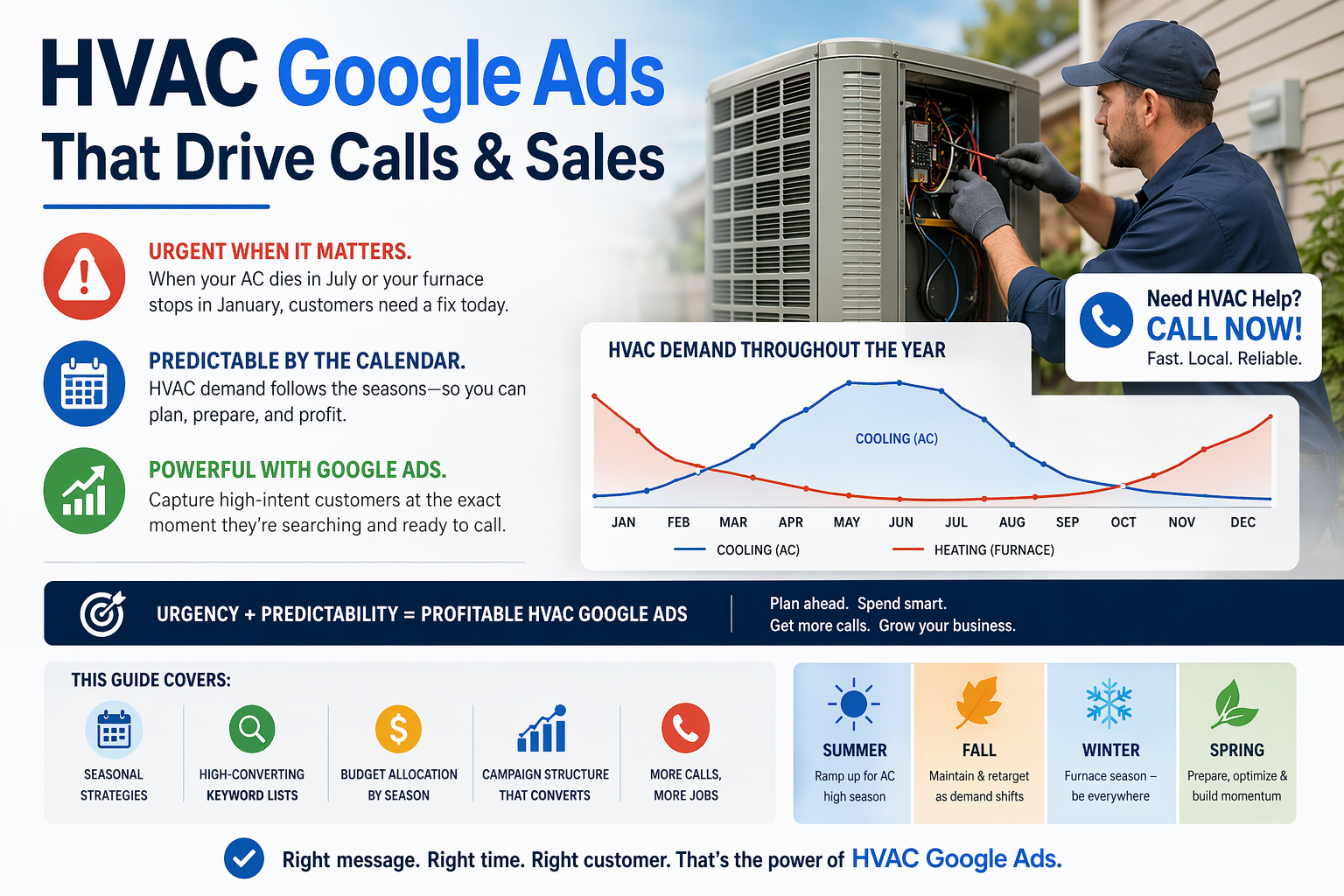
HVAC is one of the few industries where demand is both urgent and predictable. When someone’s AC dies in July or their furnace stops working in January, they need a fix today - not next week. But unlike purely emergency-driven businesses, HVAC companies also have the advantage of knowing exactly when demand will spike based on the calendar.
That combination of urgency and predictability makes Google Ads an incredibly powerful channel for HVAC businesses. You can plan your campaigns months in advance, ramp up spend when temperatures hit extremes, and scale back during mild seasons - all while capturing high-intent customers who are ready to call right now.
This guide covers everything you need to know about running profitable HVAC Google Ads campaigns, from seasonal strategies to keyword lists to budget allocation throughout the year.
Why HVAC + Google Ads = Perfect Match
The economics of HVAC advertising make Google Ads one of the highest-ROI marketing channels available:
High-intent searches. Someone typing “AC repair near me” at 2 PM on a 95-degree day isn’t browsing. They’re sweating, uncomfortable, and ready to pay whatever it takes to get their system running again. These searches convert at rates most industries can only dream of - often 15-25% from click to call.
High average ticket values. AC repairs average $300-$600, new system installations run $5,000-$15,000, and maintenance plans generate recurring revenue of $150-$300 per year. Even at higher CPCs, the math works because the revenue per customer is substantial.
Repeat business potential. An HVAC customer acquired through Google Ads today can become a maintenance plan subscriber, a referral source, and eventually a system replacement customer. The lifetime value of an HVAC customer often exceeds $10,000 when you factor in repeat service calls, maintenance, and eventual system replacement.
Predictable seasonality. Unlike businesses with random demand fluctuations, HVAC follows weather patterns. You can plan campaigns, budgets, and ad copy months in advance.
Seasonal Strategy: Summer AC vs Winter Heating
The biggest differentiator in HVAC advertising is seasonality. Your campaigns should look fundamentally different in January than they do in July.
Summer Strategy (May - September)
Summer is peak season for most HVAC companies, especially in southern states. AC-related searches can spike 300-500% compared to winter months.
Focus keywords: AC repair, air conditioning not working, AC not blowing cold air, central air repair, AC unit replacement, new AC installation
Ad copy emphasis: Speed of response (“Same-Day AC Repair”), relief from heat (“Get Cool Fast”), and financing for installations (“New AC Systems - 0% Financing Available”)
Budget: Increase to 150-200% of your baseline during peak summer months. The demand is there - you just need to capture it.
Common mistake: Not increasing budget fast enough when the first heat wave hits. Many HVAC companies set a fixed monthly budget and then wonder why their ads stop showing at 2 PM when search volume spikes. Use shared budgets or increase daily caps during heat events.
Winter Strategy (November - March)
Heating season brings a different set of searches and a different customer mindset.
Focus keywords: furnace repair, heater not working, no heat in house, furnace not turning on, heating repair near me, boiler repair
Ad copy emphasis: Safety (“Don’t Risk a Cold Night”), urgency (“24/7 Emergency Heating Repair”), and comfort (“Restore Your Heat in Hours, Not Days”)
Budget: In northern markets, winter budgets should match or exceed summer budgets. In southern markets, heating demand is typically 40-60% of summer volume.
Shoulder Seasons (April, October)
These transitional months are when smart HVAC companies make their money on maintenance and installations.
Focus keywords: AC tune-up, furnace maintenance, HVAC maintenance plan, heating and cooling checkup, system replacement
Ad copy emphasis: Preventive care (“Avoid a Breakdown This Summer - Schedule Your Tune-Up”), and replacement planning (“Is Your AC Over 10 Years Old? Save With a New System”)
Budget: Lower than peak seasons, but don’t go to zero. Shoulder seasons are ideal for promoting maintenance plans and locking in installation projects before the rush.
Campaign Structure for HVAC Companies
Your HVAC account should be organized around service types and urgency levels:
Campaign 1: Emergency Repair (Highest Priority) Ad groups: AC repair, heating repair, HVAC emergency, no heat, no cooling Bid strategy: Maximize conversions or target CPA Schedule: 24/7 during season
Campaign 2: AC Services (Seasonal) Ad groups: AC installation, AC replacement, AC tune-up, AC maintenance Bid strategy: Target CPA Schedule: March - October
Campaign 3: Heating Services (Seasonal) Ad groups: Furnace repair, furnace installation, boiler service, heating maintenance Bid strategy: Target CPA Schedule: September - April
Campaign 4: Maintenance Plans Ad groups: HVAC maintenance plan, AC tune-up plan, heating checkup plan Bid strategy: Target CPA Schedule: Year-round, increase during shoulder seasons
Campaign 5: Commercial HVAC Ad groups: Commercial AC, commercial heating, rooftop unit repair, commercial HVAC maintenance Bid strategy: Maximize conversions Schedule: Year-round
Campaign 6: LSAs Separate from your search campaigns, run Local Services Ads year-round.
HVAC Keyword Research: Seasonal Keyword Lists
Emergency and Repair Keywords (Year-Round)
- HVAC repair near me
- AC repair near me
- heating repair near me
- emergency HVAC service
- HVAC technician near me
- air conditioning not working
- furnace not turning on
- AC blowing warm air
- heater blowing cold air
- HVAC emergency service
AC-Specific Keywords (Summer)
- AC installation
- new air conditioner cost
- central air installation
- AC replacement
- AC tune-up
- AC maintenance
- window AC installation
- ductless AC installation
- AC unit not cooling
- freon recharge
- AC compressor repair
Heating-Specific Keywords (Winter)
- furnace repair
- furnace installation
- new furnace cost
- boiler repair
- heat pump repair
- heating system replacement
- furnace tune-up
- pilot light not working
- furnace blowing cold air
- radiant heating repair
Maintenance and Plan Keywords (Shoulder Seasons)
- HVAC maintenance plan
- AC tune-up near me
- furnace maintenance
- heating and cooling checkup
- HVAC service contract
- annual HVAC inspection
CPC and CPL Benchmarks for HVAC
HVAC advertising costs vary significantly by season and market, but here are current benchmarks:
Average CPC by keyword type: - Emergency repair keywords: $12-$30 - Installation keywords: $15-$40 - Maintenance keywords: $6-$15 - Brand keywords: $1-$3
Average cost per lead: $35-$80 for repair calls, $50-$120 for installation leads, $20-$40 for maintenance inquiries.
Seasonal CPC variation: CPCs can increase 30-50% during peak demand periods. A keyword that costs $15 in April might cost $22 in July. Factor this into your budget planning.
What determines your actual costs: Market size, number of competitors bidding on the same keywords, your Quality Score (determined by ad relevance, landing page quality, and expected CTR), and time of day. CPCs tend to be highest between 10 AM and 4 PM when competition peaks.
Ad Copy for Each Season
Your ad copy should change with the seasons. Here are proven headline and description formulas:
Summer AC Headlines
- “AC Broken? Same-Day Repair - [City]”
- “24/7 AC Repair - Cool Your Home Fast”
- “New AC System - 0% Financing Available”
- “AC Not Cooling? Licensed Techs On Call Now”
Winter Heating Headlines
- “No Heat? Emergency Furnace Repair - 24/7”
- “Furnace Repair - Restore Heat in Hours”
- “New Furnace Installation - Winter Special”
- “[City] Heating Repair - Same-Day Service”
Shoulder Season Headlines
- “AC Tune-Up - $89 Spring Special”
- “Avoid Summer Breakdowns - Schedule Maintenance”
- “HVAC Maintenance Plans Starting at $14/Month”
- “Is Your System 10+ Years Old? Free Replacement Quote”
Description Best Practices
Always include: response time, licensing, financing options (for installations), and a clear call to action. Mention specific dollar amounts when possible - “$89 tune-up” is more compelling than “affordable maintenance.”
Landing Pages Per Service Type
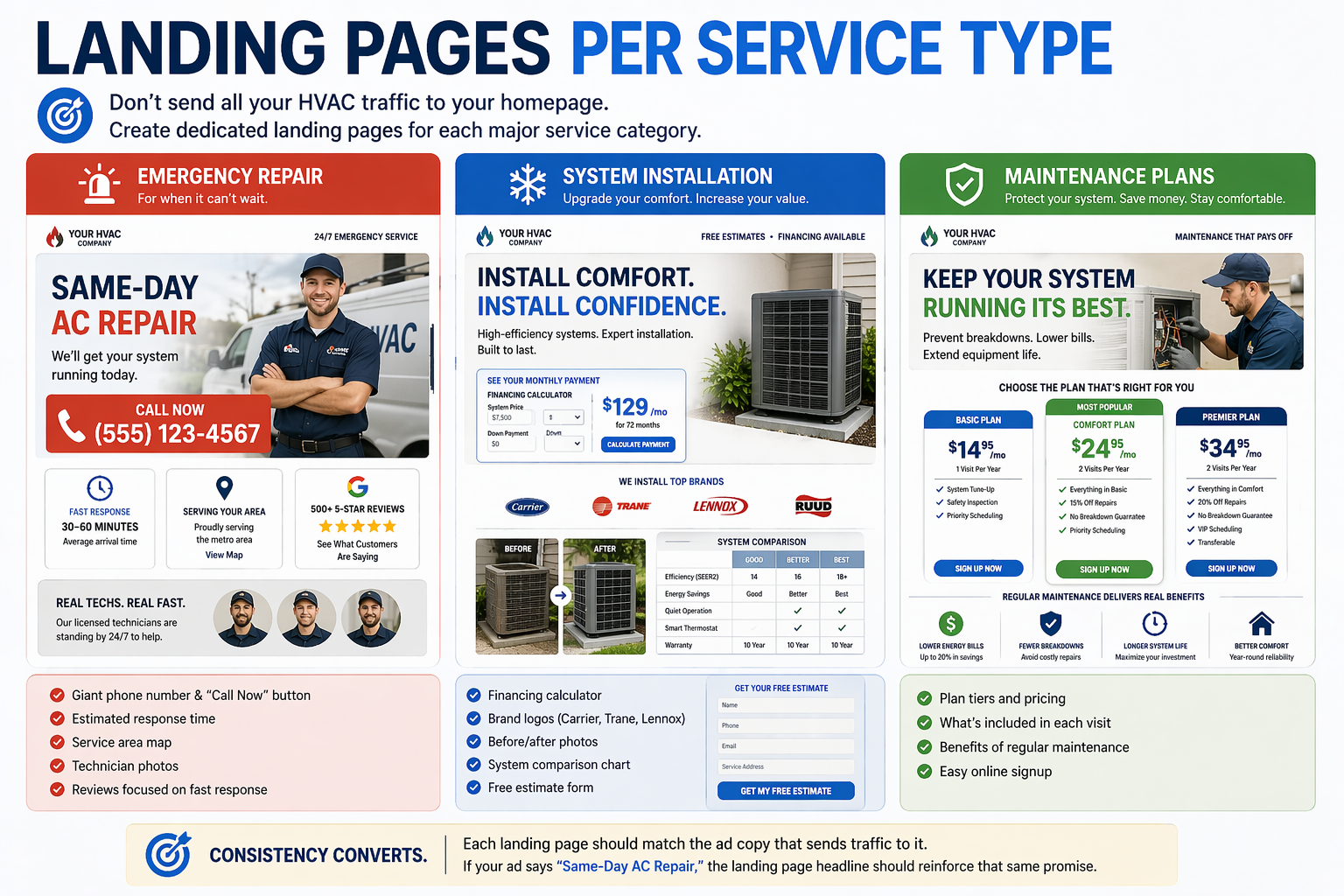
Don’t send all your HVAC traffic to your homepage. Create dedicated landing pages for each major service category:
Emergency repair landing page: Giant phone number, “Call Now” button, estimated response time, service area map, technician photos, reviews focused on fast response.
Installation landing page: Financing calculator, brand logos (Carrier, Trane, Lennox), before/after photos, system comparison chart, free estimate form.
Maintenance plan landing page: Plan tiers and pricing, what’s included in each visit, benefits of regular maintenance (energy savings, extended equipment life), easy online signup.
Each landing page should match the ad copy that sends traffic to it. If your ad says “Same-Day AC Repair,” the landing page headline should reinforce that same promise.
Selling Maintenance Plans Through Ads
Maintenance plans are the HVAC industry’s secret to recurring revenue, and Google Ads can be an effective channel for selling them - especially during shoulder seasons when repair demand is lower.
Target keywords like “HVAC maintenance plan,” “AC tune-up plan,” and “heating service contract.” These tend to have lower CPCs ($6-$15) because fewer competitors bid on them.
Emphasize the value in your ad copy: “$14/month protects your $8,000 system” or “Maintenance plan members get priority emergency service.”
Create a dedicated landing page that explains plan tiers, lists what each visit includes, and makes it easy to sign up online. Include a calculator showing how much customers save over time versus paying for individual service calls.
The CPL for maintenance plan signups is typically $20-$40, and the lifetime value of a maintenance plan customer far exceeds that initial acquisition cost.
LSA Strategy for HVAC
Local Services Ads are essential for HVAC companies. They appear above search ads and carry the Google Verified badge, which builds instant trust.
HVAC LSA lead costs typically range from $25-$65, varying by service type and market. Emergency leads cost more but convert at higher rates.
Optimize your LSA profile by selecting all relevant service categories (heating repair, AC repair, installation, maintenance), adding high-quality photos of your team and work, and maintaining fast response times.
Reviews are the biggest ranking factor for LSAs. Ask every satisfied customer for a Google review. Businesses with more reviews and higher ratings consistently rank higher in LSA results.
Run LSAs alongside search ads. They serve different placements and different customer segments. Some customers click on the verified badge; others prefer the traditional search ad format. Running both maximizes your visibility.
Need More Calls for Your Business?
Google Ads Experts • High-Intent Leads • Fast Setup
Competitor Analysis Tactics
In competitive HVAC markets, understanding what your competitors are doing helps you differentiate.
Use Google’s ad transparency tools to see competitor ad copy. Search for your target keywords and study the ads that appear. Note their value propositions, pricing, and unique offers.
Check competitor landing pages. Are they using dedicated landing pages or their homepage? What trust signals do they display? What’s their form look like?
Monitor competitor reviews. Their weak spots are your opportunities. If competitors consistently get complaints about slow response times, emphasize your speed. If they get pricing complaints, emphasize transparent pricing.
Track competitor budgets seasonally. Some competitors disappear during shoulder seasons, creating lower CPCs and easier wins. Others dominate peak season but have weak non-emergency campaigns.
Budget Allocation by Season
Smart HVAC companies don’t spend the same amount every month. Here’s a framework:
Peak season (June-August for AC, December-February for heating): 150-200% of baseline. This is when demand is highest and ROI is strongest.
Shoulder seasons (April-May, September-October): 75-100% of baseline. Focus shifts to maintenance plans and installation projects.
Off-peak (March, November): 50-75% of baseline. Maintain visibility but don’t overspend when demand is lowest.
Monthly budget ranges by market size: - Small market: $1,500-$3,000/month baseline - Mid-size market: $3,000-$6,000/month baseline - Large metro: $6,000-$15,000/month baseline
Remember, these are baseline numbers. Peak months should be higher, off-peak can be lower.
Call Tracking and CRM Integration
For HVAC companies, tracking phone calls from ads is essential because the vast majority of conversions happen over the phone, not through web forms.
Set up Google Ads call tracking at minimum. This tells you which campaigns and keywords generate calls.
Use a third-party call tracking solution like CallRail or CallTrackingMetrics for deeper insights. These tools record calls (with disclosure), score lead quality, and integrate with your CRM or dispatch software.
Connect your call data to your CRM so you can track which ad keywords lead to booked appointments, completed jobs, and revenue. This end-to-end attribution lets you optimize for revenue, not just call volume.
Set a minimum call duration threshold - typically 60 seconds - to filter out wrong numbers and very short calls. This gives you a more accurate picture of your true lead volume and cost per lead.
Performance Max for HVAC
Performance Max campaigns use Google’s AI to show ads across Search, Maps, YouTube, Gmail, and the Display Network. For HVAC companies, PMax can be a good supplement to traditional search campaigns, but it’s not where you should start.
When to add PMax: After you have at least 30-50 conversions per month from your search campaigns. PMax needs conversion data to optimize effectively. Without enough data, Google’s algorithm makes poor decisions.
Asset groups for HVAC PMax: Create separate asset groups for each service type (AC repair, heating repair, installation, maintenance). Provide 5-10 headlines, 3-5 descriptions, relevant images of your team and work, and your logo.
Budget allocation: Start with 20-25% of your total Google Ads budget on PMax. If performance justifies it, gradually increase. Never let PMax cannibalize your proven search campaigns.
Common HVAC Ad Mistakes
Mistake 1: One campaign for everything. Lumping AC repair, furnace installation, and maintenance into a single campaign gives you no control over budget allocation or bidding by service type.
Mistake 2: Not adjusting for seasonality. Running the same budget and same ads in July as you do in November wastes money in slow months and misses opportunities in busy months.
Mistake 3: Sending all traffic to the homepage. Your homepage isn’t designed to convert someone who searched “emergency AC repair.” Create service-specific landing pages.
Mistake 4: Ignoring mobile. Over 70% of HVAC emergency searches happen on mobile. If your landing page isn’t optimized for mobile with a click-to-call button front and center, you’re losing leads.
Mistake 5: No call tracking. If you’re not tracking which keywords drive phone calls, you’re optimizing blind. Most HVAC leads come through calls, not forms.
Mistake 6: Not running LSAs. Local Services Ads are too valuable to ignore. The Google Verified badge builds trust, and the pay-per-lead model protects your budget.
Mistake 7: Ignoring maintenance plan promotion. Many HVAC companies focus exclusively on repair and installation ads. Maintenance plans generate lower-cost leads with higher lifetime value.
