

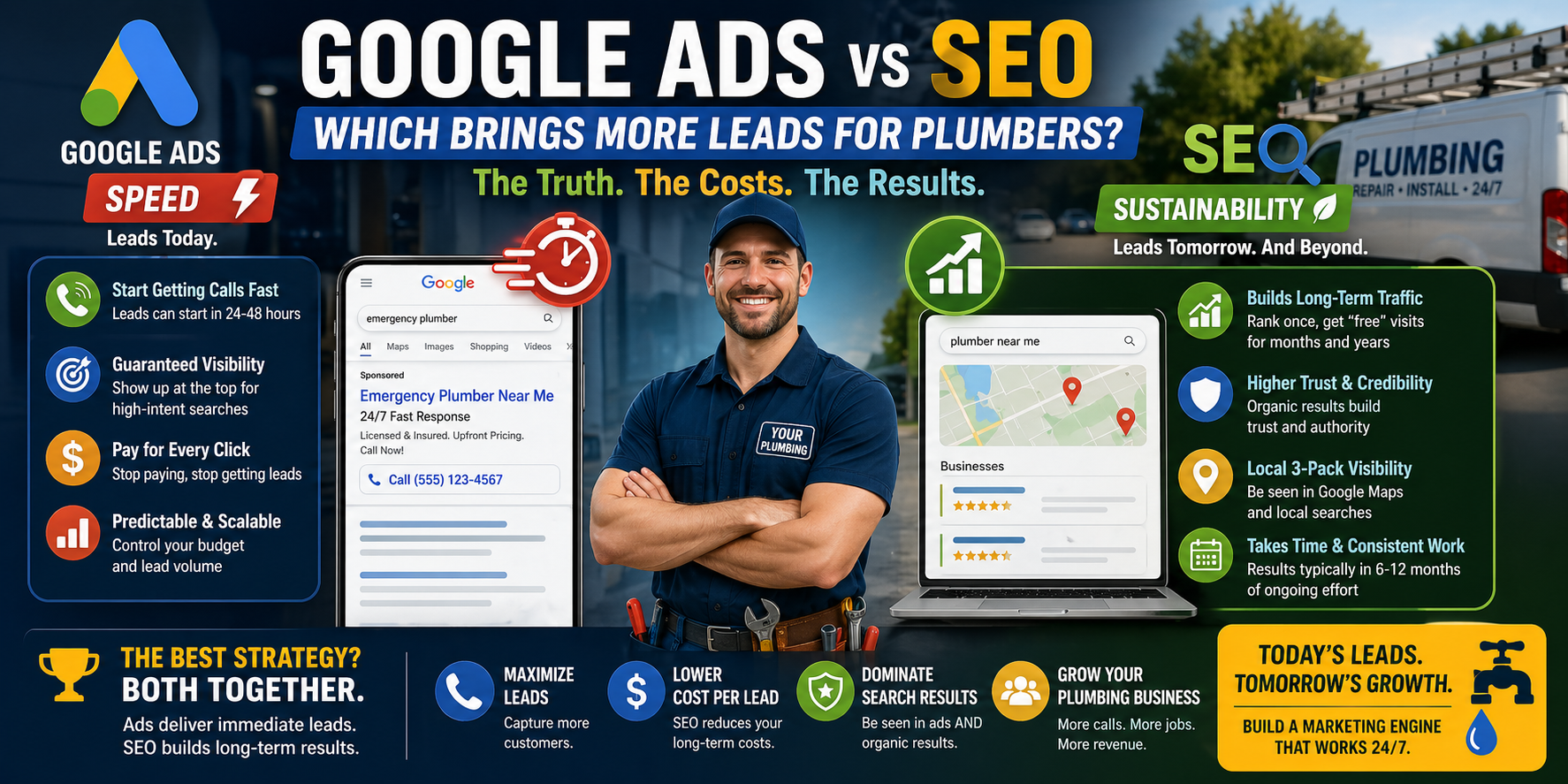
Every plumber at some point asks the same question: should I invest in Google Ads or SEO? The short answer is both. The real answer depends on where your business is today, how fast you need leads, and what you can afford.
Google Ads gives you leads today. You turn on a campaign, and within hours, your phone can start ringing. But you pay for every click, and the moment you stop paying, the leads stop.
SEO builds a sustainable lead machine over months. Once you rank, you get “free” traffic - no per-click cost. But getting to page one takes 6-12 months of consistent work, and there’s no guarantee you’ll rank for competitive keywords.
This guide compares the two head-to-head with real numbers, so you can make an informed decision about where to put your marketing dollars.
The Core Difference: Speed vs Sustainability
Google Ads = speed. You launch a campaign today. By tomorrow, you’re showing up for “emergency plumber near me.” Within a week, you have real performance data and (hopefully) booked jobs. Google Ads is the fastest path from zero to leads.
SEO = sustainability. You optimize your website, create content, build citations, and earn backlinks. Over 6-12 months, you climb the rankings. Once you reach page one for your target keywords, you receive organic clicks without paying per click. SEO is the most cost-efficient path to long-term leads, but it requires patience.
Neither is inherently “better.” They solve different problems on different timelines.
Google Ads: Pros and Cons for Plumbers
Pros
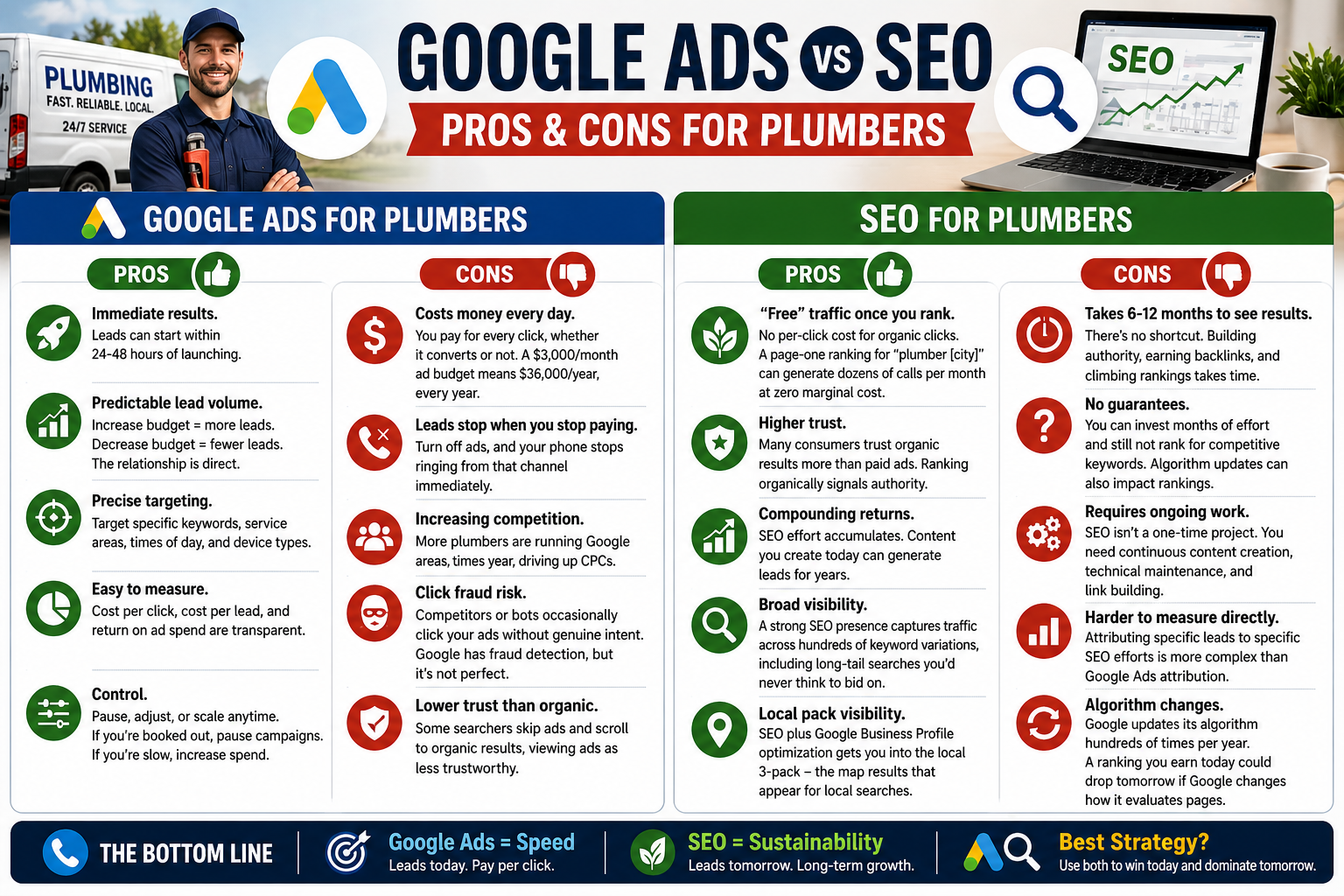
- Immediate results. Leads can start within 24-48 hours of launching.
- Predictable lead volume. Increase budget = more leads. Decrease budget = fewer leads. The relationship is direct.
- Precise targeting. Target specific keywords, service areas, times of day, and device types.
- Easy to measure. Cost per click, cost per lead, and return on ad spend are transparent.
- Control. Pause, adjust, or scale anytime. If you’re booked out, pause campaigns. If you’re slow, increase spend.
Cons
- Costs money every day. You pay for every click, whether it converts or not. A $3,000/month ad budget means $36,000/year, every year.
- Leads stop when you stop paying. Turn off ads, and your phone stops ringing from that channel immediately.
- Increasing competition. More plumbers are running Google Ads every year, driving up CPCs.
- Click fraud risk. Competitors or bots occasionally click your ads without genuine intent. Google has fraud detection, but it’s not perfect.
- Lower trust than organic. Some searchers skip ads and scroll to organic results, viewing ads as less trustworthy.
SEO: Pros and Cons for Plumbers
Pros
- “Free” traffic once you rank. No per-click cost for organic clicks. A page-one ranking for “plumber [city]” can generate dozens of calls per month at zero marginal cost.
- Higher trust. Many consumers trust organic results more than paid ads. Ranking organically signals authority.
- Compounding returns. SEO effort accumulates. Content you create today can generate leads for years.
- Broad visibility. A strong SEO presence captures traffic across hundreds of keyword variations, including long-tail searches you’d never think to bid on.
- Local pack visibility. SEO plus Google Business Profile optimization gets you into the local 3-pack - the map results that appear for local searches.
Cons
- Takes 6-12 months to see results. There’s no shortcut. Building authority, earning backlinks, and climbing rankings takes time.
- No guarantees. You can invest months of effort and still not rank for competitive keywords. Algorithm updates can also impact rankings.
- Requires ongoing work. SEO isn’t a one-time project. You need continuous content creation, technical maintenance, and link building.
- Harder to measure directly. Attributing specific leads to specific SEO efforts is more complex than Google Ads attribution.
- Algorithm changes. Google updates its algorithm hundreds of times per year. A ranking you earn today could drop tomorrow if Google changes how it evaluates pages.
Cost Comparison Over 12 Months
Let’s compare realistic costs for a plumbing business in a mid-size US market:
Google Ads: 12-Month Cost
- Monthly ad spend: $2,500
- Monthly management (if using an agency): $500-$1,000
- Total annual cost: $30,000-$42,000
- Estimated leads: 600-900 (at $35-$50 per lead)
- Leads per month: 50-75
SEO: 12-Month Cost
- Monthly SEO investment (agency or consultant): $1,500-$3,000
- Content creation: $500-$1,000/month
- Total annual cost: $24,000-$48,000
- Estimated leads in months 1-6: Minimal (0-20 total)
- Estimated leads in months 7-12: Growing (20-50 per month)
- Total year-one leads: 100-300
The math at first glance
Google Ads delivers more leads in year one because leads start immediately. SEO starts slow but accelerates. By month 12, SEO lead flow may match or exceed Google Ads - and it continues into year two without the same recurring ad spend.
The real comparison is year two
In year two, Google Ads costs another $30,000-$42,000 for roughly the same lead volume. SEO costs drop to $12,000-$24,000 (maintenance is cheaper than initial build) while lead volume continues growing. Over a two-year horizon, SEO becomes significantly more cost-efficient - if it succeeds.
Lead Quality Comparison
Lead quality differs between the two channels:
Google Ads leads are typically high-intent but can include more tire-kickers. Because ads appear for anyone searching, you’ll get some calls from people comparing prices or asking questions without intending to hire. Average close rate from Google Ads leads: 25-40%.
SEO leads tend to be slightly higher quality. Organic searchers often spend more time on your site reading content, reviews, and service descriptions before calling. They arrive more informed and closer to a decision. Average close rate from SEO leads: 30-50%.
LSA leads (which overlap with both channels) are among the highest quality because the Google Verified badge pre-filters for trust. Close rates from LSA leads often exceed 40%.
The difference is meaningful but not dramatic. Both channels produce qualified leads. The quality gap narrows significantly when you have optimized landing pages for your Google Ads campaigns.
Real Case Study: Ads-Only vs SEO-Only vs Both
Consider three hypothetical plumbing businesses in the same market:
Plumber A (Ads Only): Spends $3,000/month on Google Ads. Generates 60 leads/month consistently from month one. Pays $36,000/year for those leads indefinitely.
Plumber B (SEO Only): Invests $2,500/month in SEO. Gets almost zero leads for the first 5 months. By month 8, getting 30 leads/month. By month 12, getting 50 leads/month. Pays $30,000 in year one. In year two, reduces to $1,500/month maintenance and generates 60+ leads/month.
Plumber C (Both): Spends $2,000/month on Google Ads and $2,000/month on SEO. Gets 40 leads/month from ads starting month one. By month 8, adds 20+ leads from SEO. By month 12, getting 60+ leads from both channels. Total cost is higher in year one ($48,000), but by year two, Plumber C can reduce ad spend as SEO fills the gap, achieving more leads at lower total cost.
The winner over 2 years: Plumber C. The combined strategy provides immediate leads from ads while building the long-term SEO asset. By year two, Plumber C has the most leads at the lowest cost per lead.
When to Start with Ads
Google Ads should be your first investment if:
- You’re a new business and need leads this month. You can’t wait 6-12 months for SEO to kick in while paying rent and payroll.
- You need predictable lead flow. You have capacity to serve more customers and want to control exactly how many leads come in.
- You’re in a highly competitive market. In major metros, SEO for plumbing is extremely competitive. Google Ads gets you visibility immediately while you work on organic rankings over time.
- You’re testing a new service area. Expanding into a new city? Ads let you test demand before committing to a long-term SEO campaign.
When to Invest in SEO
SEO should be a priority if:
- You already have steady leads from ads and want to reduce your customer acquisition cost over time.
- You’re an established business with an existing website that has some domain authority.
- You’re willing to invest for 6-12 months before seeing significant results. You need financial runway.
- You want to reduce dependence on paid advertising. Every lead from organic search is a lead you didn’t pay per-click for.
- You want local pack visibility. Google’s local 3-pack (map results) is primarily driven by SEO and Google Business Profile optimization. Ads can’t buy that position.
The Ideal Strategy: Running Both Together
For most plumbing businesses with the budget to support it, running both Google Ads and SEO simultaneously is the optimal strategy. Here’s why:
Ads provide immediate revenue while SEO builds over time. You’re never in a situation where you’re waiting months for leads.
Ad data informs SEO strategy. Your Google Ads campaigns reveal which keywords convert best, which search terms have the highest intent, and what landing page messaging resonates. Use this data to prioritize your SEO content creation.
SEO reduces your long-term ad dependence. As organic rankings improve, you can gradually reduce ad spend on keywords where you rank organically, reallocating that budget to new keyword opportunities.
Dual visibility dominates the search results. When your business appears in both the ads section AND the organic results for the same search, your credibility and click-through rate increase significantly. The searcher sees your name twice and perceives you as the dominant local option.
Using Ad Data to Inform SEO Strategy
One of the biggest advantages of running ads alongside SEO is the data you get:
Keyword conversion data. Your Google Ads search terms report shows exactly which keywords generate phone calls and booked jobs. Use this to prioritize which keywords to target with SEO content. Why guess which keywords to write blog posts about when your ad data already tells you which ones convert?
Landing page insights. A/B test landing page headlines, CTAs, and layouts through Google Ads. Once you find what converts best, apply those learnings to your organic landing pages.
Geographic insights. Your ad data shows which neighborhoods and zip codes generate the most valuable leads. Focus your local SEO efforts (Google Business Profile, local citations, location-specific content) on those areas.
Seasonal trends. Ad data reveals seasonal search patterns. Use this to time your SEO content - publish your “frozen pipe repair” content in early fall so it’s indexed and ranking before winter demand spikes.
Budget Allocation Between Ads and SEO
There’s no one-size-fits-all split, but here are frameworks based on business stage:
New business (year 1): 70% Google Ads, 30% SEO. Prioritize immediate lead generation while laying the SEO foundation.
Growing business (years 2-3): 50% Google Ads, 50% SEO. As organic rankings improve, balance the investment between both channels.
Established business (year 4+): 30% Google Ads, 70% SEO. By now, SEO should be generating significant organic traffic. Use ads for competitive keywords, new service areas, and seasonal demand spikes.
Total monthly marketing budget guidance: - Minimum viable: $2,000/month (split between ads and basic SEO) - Competitive: $4,000-$6,000/month - Dominant: $8,000-$15,000/month
Timeline Expectations for Each
Google Ads timeline: - Day 1-7: Campaigns live, data collecting, initial clicks and calls - Week 2-4: First optimization cycle, adding negatives, adjusting bids - Month 2-3: Campaigns stabilizing, cost per lead becoming predictable - Month 3+: Ongoing optimization, scaling what works
SEO timeline: - Month 1-2: Technical audit, site fixes, Google Business Profile optimization, initial content - Month 3-4: Content creation, citation building, review strategy - Month 5-6: Early ranking improvements for low-competition keywords - Month 7-9: Rankings improving for medium-competition keywords, organic traffic growing - Month 10-12: Ranking for primary keywords, meaningful organic lead flow beginning - Year 2+: Compounding growth, reducing per-lead costs
The plumber who combines both channels strategically will always outperform the plumber who goes all-in on just one. Google Ads gives you today’s leads. SEO gives you tomorrow’s. Together, they give you a business that grows profitably over time while never going hungry for new customers.
