

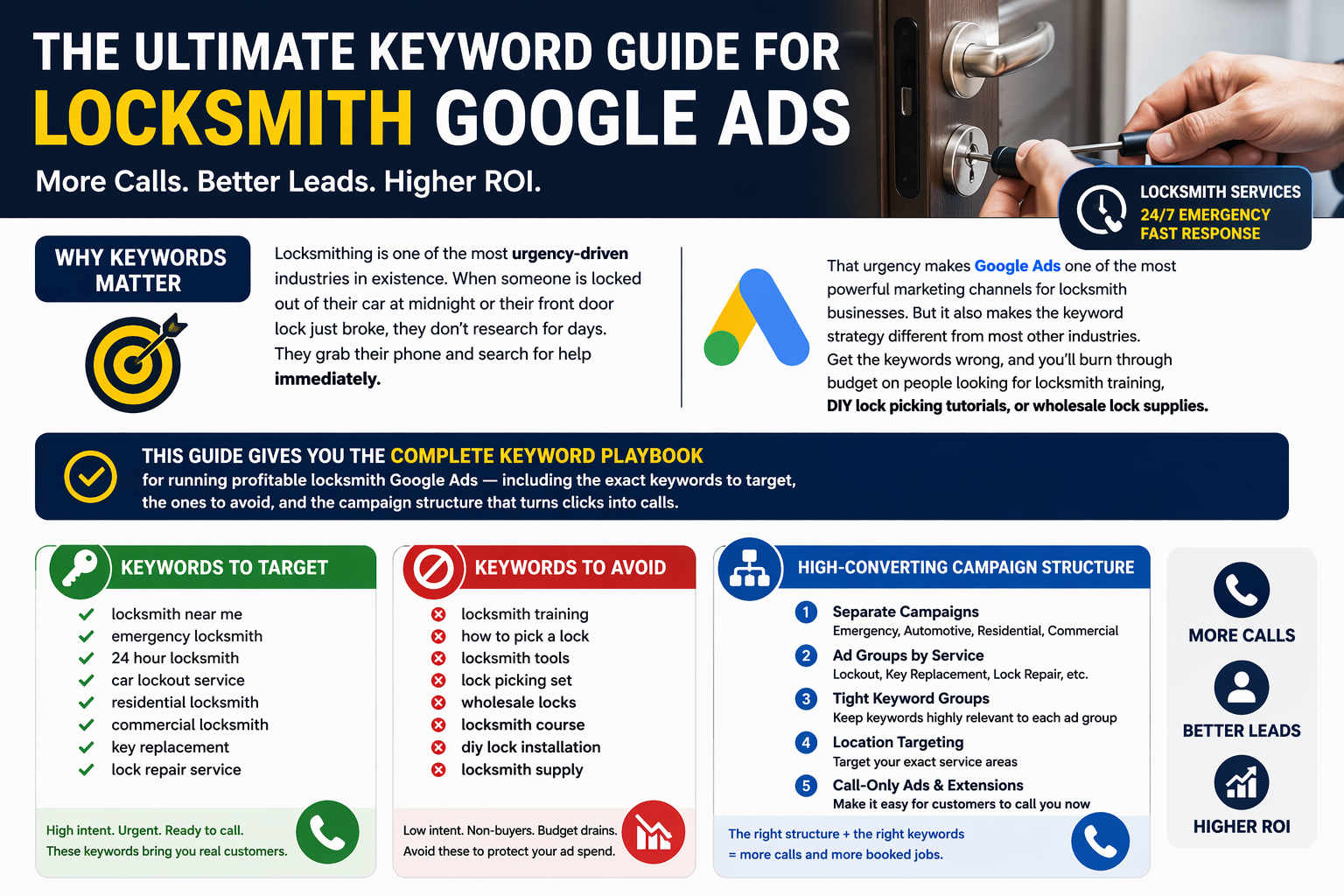
Locksmithing is one of the most urgency-driven industries in existence. When someone is locked out of their car at midnight or their front door lock just broke, they don’t research for days. They grab their phone and search for help immediately.
That urgency makes Google Ads one of the most powerful marketing channels for locksmith businesses. But it also makes the keyword strategy different from most other industries. Get the keywords wrong, and you’ll burn through budget on people looking for locksmith training, DIY lock picking tutorials, or wholesale lock supplies.
This guide gives you the complete keyword playbook for running profitable locksmith Google Ads - including the exact keywords to target, the ones to avoid, and the campaign structure that turns clicks into calls.
Locksmith Search Intent: Almost Entirely Emergency
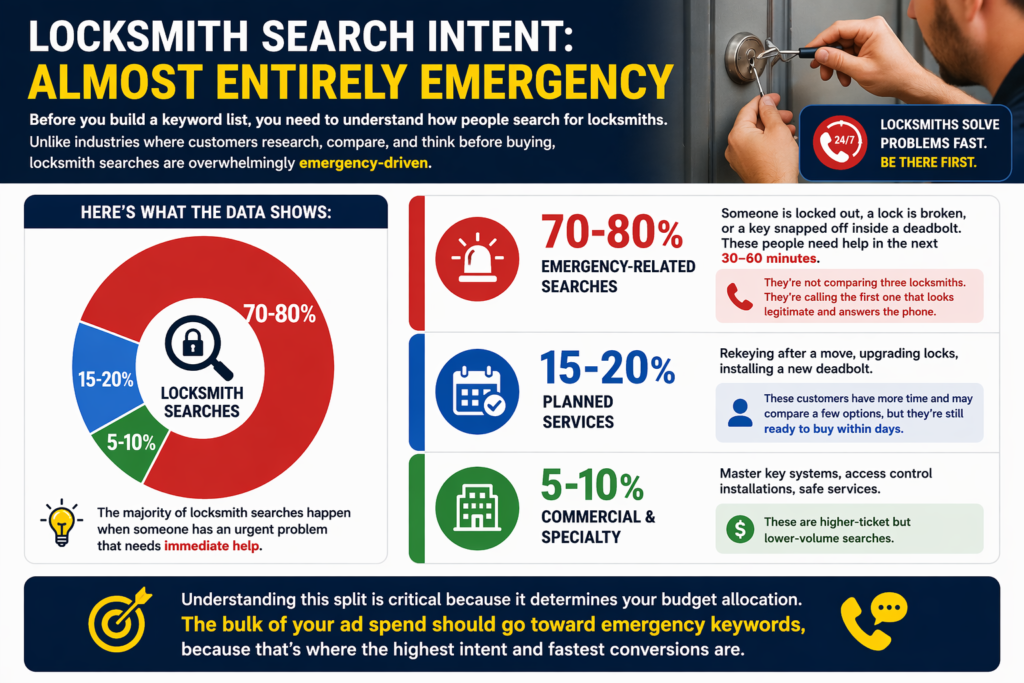
Before you build a keyword list, you need to understand how people search for locksmiths. Unlike industries where customers research, compare, and think before buying, locksmith searches are overwhelmingly emergency-driven.
Here’s what the data shows:
About 70-80% of locksmith searches are emergency-related. Someone is locked out, a lock is broken, or a key snapped off inside a deadbolt. These people need help in the next 30-60 minutes. They’re not comparing three locksmiths. They’re calling the first one that looks legitimate and answers the phone.
15-20% are planned services. Rekeying after a move, upgrading locks, installing a new deadbolt. These customers have more time and may compare a few options, but they’re still ready to buy within days.
5-10% are commercial and specialty. Master key systems, access control installations, safe services. These are higher-ticket but lower-volume searches.
Understanding this split is critical because it determines your budget allocation. The bulk of your ad spend should go toward emergency keywords, because that’s where the highest intent and fastest conversions are.
Top 50 Locksmith Keywords by Category
Here are the keywords your locksmith business should be targeting, organized by service type and intent level.
Emergency Lockout Keywords (Highest Intent)
These are your money keywords. People searching these terms need help right now.
- locksmith near me
- emergency locksmith
- locked out of house
- locked out of car
- 24 hour locksmith
- locksmith open now
- emergency locksmith near me
- car lockout service
- house lockout service
- locksmith 24/7
- after hours locksmith
- mobile locksmith near me
- auto locksmith near me
Residential Locksmith Keywords
- lock change service
- rekey locks
- deadbolt installation
- lock replacement
- home locksmith
- residential locksmith
- new lock installation
- door lock repair
- smart lock installation
- lock rekey after moving
Commercial Locksmith Keywords
- commercial locksmith
- office lockout
- master key system
- commercial lock change
- access control installation
- business locksmith
- panic bar installation
- commercial door lock repair
- keypad lock installation
Automotive Locksmith Keywords
- car key replacement
- transponder key programming
- key fob replacement
- car key duplication
- ignition repair
- broken car key extraction
- smart key programming
- lost car keys
CPC Benchmarks for Locksmith Keywords
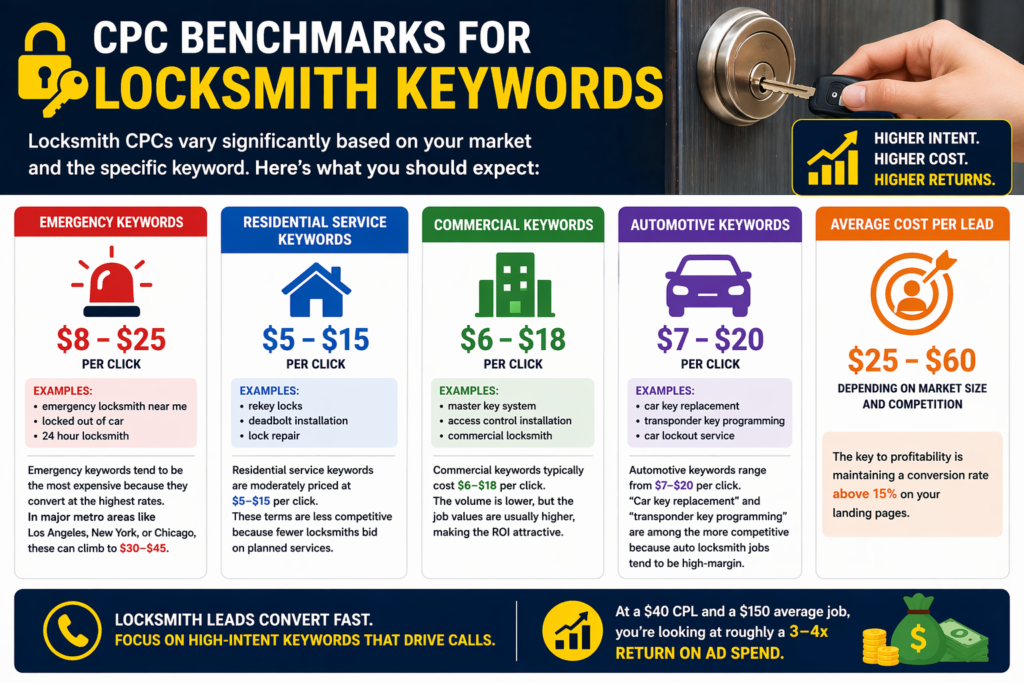
Locksmith CPCs vary significantly based on your market and the specific keyword. Here’s what you should expect:
Emergency keywords tend to be the most expensive because they convert at the highest rates. Expect to pay $8-$25 per click for terms like “emergency locksmith near me” and “locked out of car.” In major metro areas like Los Angeles, New York, or Chicago, these can climb to $30-$45.
Residential service keywords are moderately priced at $5-$15 per click. Terms like “rekey locks” and “deadbolt installation” are less competitive because fewer locksmiths bid on planned services.
Commercial keywords typically cost $6-$18 per click. The volume is lower, but the job values are usually higher, making the ROI attractive.
Automotive keywords range from $7-$20 per click. “Car key replacement” and “transponder key programming” are among the more competitive because auto locksmith jobs tend to be high-margin.
Average cost per lead across all keywords: $25-$60 depending on market size and competition. The key to profitability is maintaining a conversion rate above 15% on your landing pages. At a $40 CPL and a $150 average job, you’re looking at roughly a 3-4x return on ad spend.
Need More Calls for Your Business?
Google Ads Experts • High-Intent Leads • Fast Setup
Match Types Strategy for Locksmiths
Your match type strategy needs to account for the urgency-driven nature of locksmith searches. People searching in a panic often use imprecise, natural language - “I’m locked out help” or “someone to open my car door.”
Phrase match should be your primary match type for emergency keywords. It gives you enough flexibility to capture the varied ways people describe lockout situations while maintaining relevance. Set “locksmith near me” and “locked out of car” as phrase match to capture related variations.
Exact match works well for high-CPC terms where you want maximum control. Use exact match for your most expensive keywords like [emergency locksmith] and [24 hour locksmith] to control spend.
Broad match should be used sparingly and only with a robust negative keyword list. It can uncover valuable long-tail searches you might miss, but it will also pull in irrelevant traffic like “locksmith jobs” and “how to pick a lock” if you’re not careful.
A practical starting structure: 60% phrase match, 30% exact match, 10% broad match. Adjust based on your search terms report after the first two weeks.
Negative Keywords: The Locksmith Industry’s Secret Weapon
Locksmith businesses lose more money to irrelevant clicks than almost any other service industry. Your negative keyword list needs to be aggressive from day one.
Job Seeker Keywords (Block Immediately)
- locksmith jobs
- locksmith salary
- locksmith apprenticeship
- locksmith certification
- locksmith training
- become a locksmith
- locksmith career
- locksmith school
- locksmith course
DIY and Educational Keywords
- how to pick a lock
- lock picking
- lock picking tools
- lock picking set
- DIY lock change
- how to open a lock without a key
- bump key
- lock pick kit
- locksmith tools for sale
Retail and Product Keywords
- locks for sale
- deadbolt buy
- lock set
- door knob buy
- smart lock reviews
- best door locks
- lock brands
- kwikset
- schlage
- wholesale locks
Geographic Exclusions
Block city names and zip codes outside your service area. If you serve a 25-mile radius, add negative keywords for cities beyond that range.
Other Irrelevant Terms
- free locksmith
- cheap locksmith (consider keeping this — some locksmiths profitably target price-sensitive customers)
- locksmith scam
- locksmith complaint
- locksmith license lookup
Geo-Targeting for Locksmith Service Areas
Locksmiths operate within defined service areas, and your geo-targeting needs to be precise. Running ads outside your coverage wastes budget and creates unhappy customers you can’t serve.
Radius targeting works best for most locksmith businesses. Set a radius of 15-25 miles from your base of operations. If you have a physical shop, center the radius there. If you’re a mobile-only operation, center it on the area where you can respond fastest.
Zip code targeting gives you more granular control. If certain neighborhoods generate higher-value calls (commercial districts, affluent residential areas), you can bid higher for those zip codes while maintaining lower bids elsewhere.
Location bid adjustments are crucial. Increase bids by 20-30% for your core service area (within 10 miles) where response times are fastest. Decrease bids by 10-20% for the outer edges of your territory where you’re competing with closer locksmiths.
Exclude areas you don’t serve. This seems obvious, but many locksmiths forget to set negative locations and end up getting calls from 40 miles away.
Ad Copy: Urgency + Trust
Locksmith ad copy needs to accomplish two things simultaneously: convey urgency (you’ll be there fast) and build trust (you’re legitimate, not a scam operation).
The locksmith industry has a well-documented problem with scam operators — companies that advertise low prices, then show up and charge $300+ for a simple lockout. Google and consumers are both aware of this, which means your ads need to actively signal trustworthiness.
Headline formulas that work:
- “Licensed Locksmith — 20 Min Response”
- “24/7 Emergency Locksmith — Flat Rate Pricing”
- “[City] Licensed Locksmith — Bonded & Insured”
- “Locked Out? We’re 15 Min Away — No Hidden Fees”
Description elements to include:
- Response time (“15-20 minute average response”)
- Pricing transparency (“Upfront pricing, no surprises”)
- Trust signals (“Licensed, bonded, insured”)
- Years in business (“Serving [City] since 2010”)
- Reviews (“4.9★ rating from 500+ customers”)
Ad extensions to use:
- Call extension (with 24/7 hours)
- Location extension
- Sitelink extensions (Residential, Commercial, Auto, Emergency)
- Callout extensions (Licensed & Insured, Flat Rate Pricing, 24/7 Service)
- Structured snippets (Service types)
Landing Page: Mobile-First for Locked-Out Customers
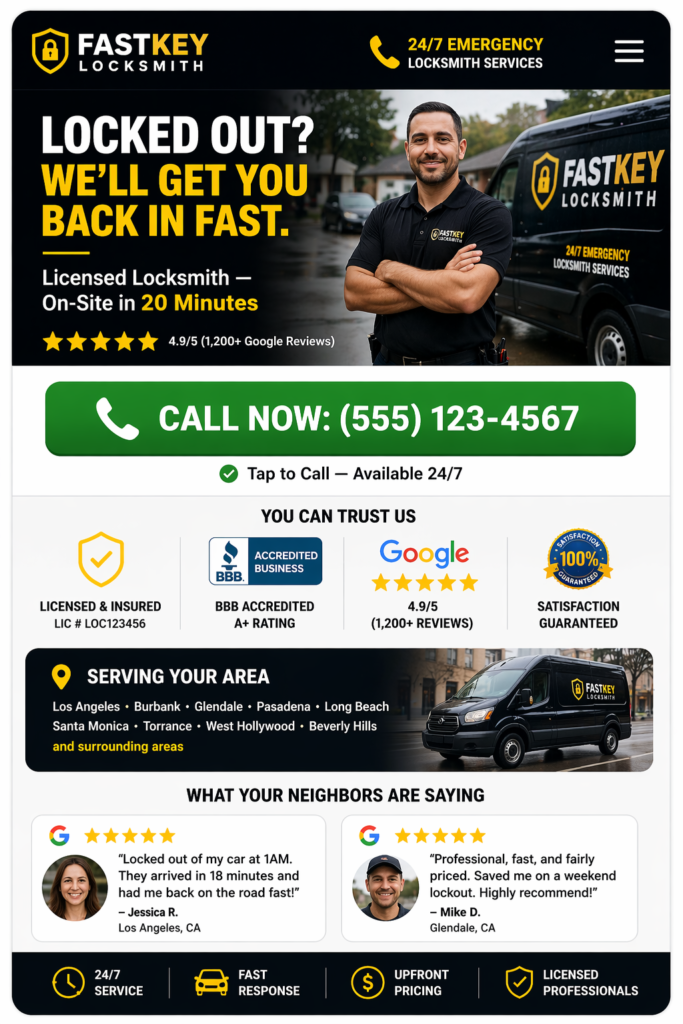
Your locksmith landing page needs to be designed for someone standing in the rain, locked out of their car, squinting at their phone. That means:
Giant click-to-call button. It should be the most prominent element on the page. A locked-out customer doesn’t want to fill out a form. They want to call you and know you’re on the way.
Load time under 3 seconds. People in emergency situations have zero patience. If your page takes 5 seconds to load, they’re hitting the back button and calling your competitor.
Above-the-fold essentials: Your phone number, a one-line value proposition (“Licensed Locksmith — On-Site in 20 Minutes”), and your star rating. Nothing else should compete for attention.
Trust elements immediately visible: License number, “BBB Accredited” badge, Google review rating, and one or two customer testimonial snippets.
No stock photos. Use photos of your actual team, your van, your uniform. Customers are already wary of locksmith scams. Generic stock photos of a smiling person holding keys doesn’t build trust — it erodes it.
Service area clearly stated. List the cities and neighborhoods you serve so the customer knows you can reach them quickly.
24/7 Campaign Scheduling
Lockouts don’t happen on a 9-to-5 schedule. In fact, some of the highest-value locksmith calls come in late at night and on weekends when fewer locksmiths are answering their phones.
Run your campaigns 24/7 if you offer round-the-clock service. Night and weekend calls often convert at higher rates because there’s less competition and more urgency.
Use ad scheduling bid adjustments to increase bids during peak lockout hours. Data across the locksmith industry shows that lockout calls spike between 6 PM and midnight on weekdays, and throughout weekends. Consider bidding 15-25% higher during these windows.
If you don’t offer 24/7 service, be transparent about it. Set your ad schedule to match your operating hours, and use ad copy that clearly states your hours. Running ads at 2 AM when you don’t answer the phone until 8 AM will tank your Google Ads quality and waste budget.
Local Services Ads for Locksmiths
Google Local Services Ads (LSAs) are arguably the most important ad format for locksmiths, because they directly address the trust problem that plagues the industry.
LSAs appear above Search Ads with a “Google Verified” badge. For locksmiths, this badge is incredibly powerful because it tells the customer that Google has verified your license, insurance, and background check. In an industry where customers are worried about being scammed, that badge is worth its weight in gold.
LSA lead costs for locksmiths typically range from $20-$55, with emergency lockout leads on the higher end. But because LSAs use a pay-per-lead model (not pay-per-click), you only pay when someone actually contacts you through the ad.
To qualify for locksmith LSAs, you’ll need to pass Google’s verification process, which includes a background check, license verification, and proof of insurance. The process takes 2-4 weeks.
Optimize your LSA profile by adding photos of your work, maintaining fast response times (Google tracks this), and consistently earning 5-star reviews. All of these factors affect your LSA ranking.
Fraud Prevention: The Scam Locksmith Problem
The locksmith industry has a unique challenge that affects your advertising strategy: scam locksmiths. These operations use fake addresses, advertise impossibly low prices, and then gouge customers on-site.
Google has taken steps to combat this (the LSA verification process is partly a response), but scam operations still exist. Here’s how to differentiate your legitimate business:
Get Google Verified through LSAs. This is the single most powerful trust signal you can display.
Display your license number in your ads and on your landing page. Scam operations don’t have real licenses.
Show your real business address (if you have a physical location). Link your Google Business Profile.
Feature your actual team in photos and videos. Scam operations use stock images because they don’t have a real team.
Collect and showcase reviews aggressively. A locksmith with 200+ reviews and a 4.8 rating is obviously legitimate. A listing with 3 reviews is suspicious.
Budget Recommendations
For locksmith Google Ads, your budget depends on your market size and growth goals.
Small market (under 250K population): $1,000-$2,000/month should generate 25-50 leads. Focus on emergency keywords and LSAs.
Mid-size market (250K-1M population): $2,000-$4,000/month should produce 40-80 leads. Add residential and automotive campaigns alongside emergency.
Large metro area (1M+ population): $4,000-$8,000/month or more. Competition is fierce, but so is demand. Run full campaigns across all service categories plus LSAs.
Budget allocation: 50% on emergency lockout keywords, 20% on automotive, 15% on residential planned services, 15% on LSAs.
Start with emergency keywords first. Once those are profitable, expand into other service categories. The worst thing you can do is spread a small budget across every keyword category from day one — you’ll get too few clicks in each category to optimize effectively.
Monitor your cost per lead weekly for the first month, then biweekly once campaigns stabilize. If your CPL is consistently above $60, review your negative keywords, landing page conversion rate, and ad copy before increasing budget.
